Author name: admin

Digital transformation
blog

Why your digital transformation is failing: and what the right consulting firm does differently 

By 2026, “digital transformation” has hit buzzword status in almost every boardroom. Everyone talks about it, but look closer and things aren’t so rosy, around 70% of digital transformation projects still flop. Companies keep pouring money into new software, chasing the latest tech, but see little to no return. And honestly, technology isn’t usually the issue. It’s the lack of a real strategy. If your digital push is sputtering, chances are you’re stuck chasing tools instead of focusing on how people and processes actually change.  That’s the big difference when it comes to top-tier digital transformation consulting firms. These companies don’t just sell you another platform and call it a day. They rethink how your whole organization delivers value and push you to do the same.  I. The “Sobering Reality”: Why Digital Transformation Fails  To fix a failing transformation, you’ve got to dig into the root causes. In 2026, the reasons for failure have evolved beyond simple budget overruns.   A lot of businesses automate messy processes without fixing them first. Throwing AI at broken workflows just speeds up the chaos. Before investing in high-tech solutions, you have to redesign the way your team operates at a basic level.  2. The Cultural Wall  At the end of the day, transformation is about people, not machines. Without a robust technology adoption strategy, employees see digital tools as more work or a threat, you can count on them ignoring them completely. Folks need to know how new technology actually helps them, or else they’ll stick to old habits and your fancy software will just gather dust.  3. Lack of a Unified Business Transformation Roadmap  Then there’s the issue of silos. Transformation projects often happen piece by piece, marketing gets a shiny new CRM, finance rolls out an ERP, but the systems don’t really connect. Without a centralized business transformation roadmap, you end up with a patchwork of disconnected tools that slow everyone down.  II. What Top Digital Transformation Consulting Firms Do Differently   The world’s most successful digital transformation consulting firms have ditched the “big bang” idea that you can roll out every new system at once and magically change everything. They focus on results, not just new features.  1. They Prioritize Strategy Over Software.   A leading digital consulting services provider starts by asking uncomfortable questions: What real business problem are we solving? What are our long-term goals? They develop a digital transformation strategy that aligns with the organization’s long-term OKRs (Objectives and Key Results) before a single line of code is written. Only after answering those do they piece together the tech.  2. They Architect “Intelligent Operations”  They’re also reimagining operations. Instead of building massive, monolithic systems, top firms now design flexible, “intelligent” setups. These use agentic AI, think autonomous agents that manage tasks across departments, so the business can adapt in real-time.  3. They Focus on “Digital Friction” Reduction  Instead of putting in more features, they hunt for places where workflows get stuck using heatmaps, session replays, or direct employee input and smooth those out.  III. The 2026 Technology Adoption Strategy  The top firms recognize that “Go-Live” isn’t the finish line, they see that moment as just the beginning. They implement a technology adoption strategy that treats software just like a new hire, and needs to be onboarded into the company.  All in all, real digital transformation takes more than buying new tech. It’s about new mindsets, better operations, and getting everybody pulling in the same direction.  IV. Strategic Comparison: Traditional vs. Elite Consulting  Feature  Traditional Consulting  Elite 2026 Consulting Firms  Focus  Feature-rich software rollout  Measurable business outcomes  Approach  “Big Bang” implementation  Agile, iterative milestones  User Support  One-time training sessions  Continuous, in-app learning  Strategy  IT-led project  Business-led transformation  AI Usage  Generative Chatbots  Agentic AI & Autonomous Workflows  V. Building Your 2026 Business Transformation Roadmap  If you’re ready to jumpstart your transformation journey, here’s a straightforward roadmap to keep you on track, no shortcuts, just the essentials:  Conclusion: The Path Forward  Digital transformation isn’t about buying flashy new tech, it’s about actually building something better. Too many efforts flop because companies treat technology like an end goal instead of a tool.  Work with the right digital transformation consulting firms, and you shift the conversation from what you’re buying to how you’ll win. In 2026, the leaders will be those who connect digital transformation strategy with human behaviour and operational excellence.  If your transformation feels stuck, get in touch for a free maturity assessment. Let’s build a business transformation roadmap that actually moves the needle.  FAQ Find Out Answers Here What are digital transformation consulting firms? They’re expert advisors who help companies plug digital technology into their operations, changing how they work and create value for their customers.  Why does digital transformation fail so often? Honestly, most stumble because they haven’t lined up their strategy, try to automate broken processes, and overlook how people feel and adapt to new technology.  What should be included in a digital transformation strategy? You need a clear vision, exec buy-in, a plan to grow and skill-up your team, solid data governance, and a cloud-first infrastructure roadmap.  How do digital consulting services differ from traditional IT support? IT support focuses on maintaining existing systems. Digital consulting services pushes for smarter growth leveraging tech to reinvent your business and stay ahead.  What is a business transformation roadmap? It’s a step-by-step playbook that shows the phases, milestones, and resources to guide you from where you are now to your digital goal.  Is AI the most important part of digital transformation in 2026? AI is important, sure, it’s the backbone but it’s not the whole story. The most important part remains the technology adoption strategy, how you get people to adopt and use the tech to drive value.  How long does a typical digital transformation take? It’s not a one-and-done project. It’s a capability you keep building. Major changes usually follow a 12-to-24 month timeline, but honestly, you never really “finish.” 
Conversion rate optimization agencies
blog

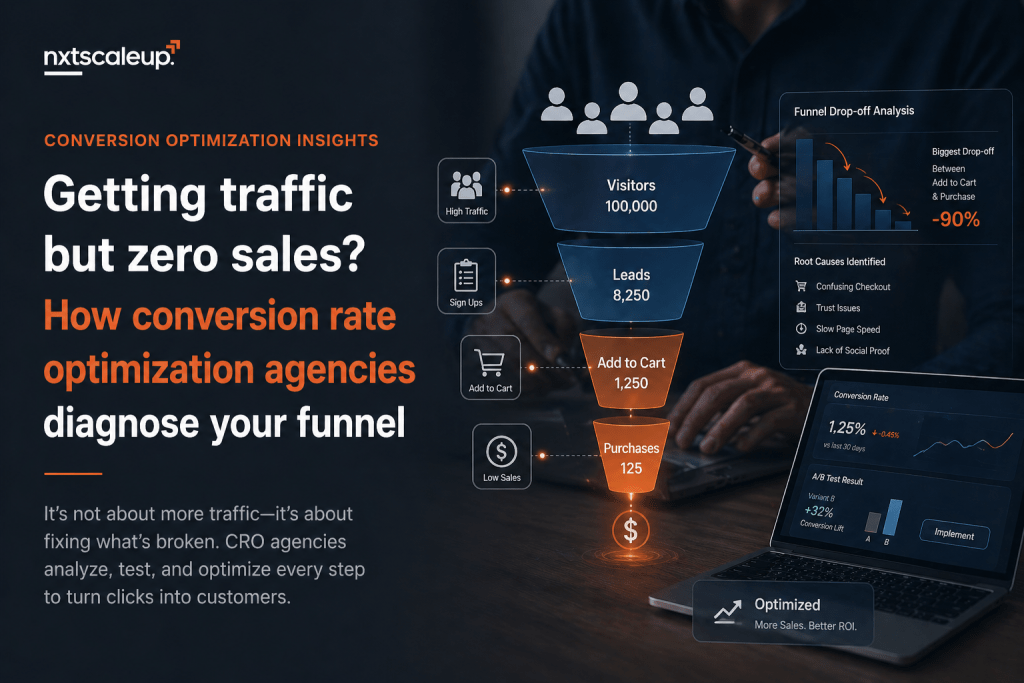
Getting traffic but zero sales? How conversion rate optimization agencies diagnose your funnel 

Getting plenty of visitors but not a single sale? It’s one of the digital world’s most annoying problems. You see your traffic numbers climbing in Google Analytics, you know your ads are spot-on, and your SEO is actually working. Yet, your revenue hasn’t budged.  In 2026, more businesses are running into this very issue. The gap between sites that attract eyeballs and sites that make money is even wider. The median website converts just 2.35% of visitors, while the top 10% are crushing it at over 11.45%. So if you’re pulling in people but not making sales, it’s not a traffic problem, it’s your website funnel optimization.  This is where conversion rate optimization agencies come in. Business owners call them up when the sales just aren’t happening, and these agencies start digging. They break down your sales funnel step by step to hunt for the hidden bottlenecks and roadblocks that are killing your conversions and improve conversion rate metrics.  Phase 1: The Sales Funnel Audit (Zooming Out)  Before they dive into design tweaks or button colors, CRO agency do a big-picture sales funnel audit. They walk through your site like it’s a real store, watching where visitors drop off, get confused, or bail out entirely.  1. Identifying the “Drop-Off” Points  Agencies lean on GA4 Funnel Exploration to lay out every step from the first click to that final “Thank You” page.  Spotting Where Your Funnel Leaks  2. Analyzing Traffic Intent  Not all visitors want the same thing. A conversion rate optimization agency looks at where your traffic’s coming from. For example, if your site ranks for “How to fix a leaky pipe” but you’re selling plumbing services, don’t expect that crowd to call you. Agencies check if your content actually matches what users want at their specific stage in the buying process.  Phase 2: Understanding Visitor Behavior (Digging Deeper)  Once agencies find where people drop off, they need to figure out what’s causing it which means looking at your site the way a visitor would.  3. Heatmaps and Click Maps  Heatmaps show the hotspots, where visitors click and just as important, the cold spots they skip.  4. Session Recordings  Agencies actually watch screen recordings of live visitors using your site. This uncovers “Silent Sales Killers” like:  Phase 3: Landing Page Optimization (The Trust View)  By 2026, trust is everything online. A landing page optimization specialist goes after the subtle psychological blockers that stop a sale.  5. Closing the 42% Mobile-Desktop Gap  Mobile brings in most of your visitors around 65% but they only convert roughly 42% half as often as desktop users. That’s a huge opportunity. Conversion rate optimization agencies focus heavily on “Mobile-only” optimization:  6. E-E-A-T and Trust Signals  If people don’t trust you, they won’t buy, period. Agencies check for:  Phase 4: Testing What Works (A/B Tests)  Finding the problem is just the start. Conversion rate optimization agencies run AI-powered A/B testing to validate their theories by running experiments with real data, not gut instinct:  The agency always lets the numbers call the shots. Every test and tweak brings a proven bump in ROI.   Conclusion: Don’t Buy More Traffic; Fix the Traffic You Have  Here’s the truth: throwing more money at ads won’t fix a leaky website. More traffic just means more people running into the same issues.  Working with Conversion rate optimization agencies, you turn your site into a real sales engine, not just a digital brochure. Whether it’s a detailed sales funnel audit or smart landing page optimization, the goal is to make buying so easy that people don’t hesitate.  Ready to turn clicks into actual customers? Reach out for a free Funnel Diagnostic, and let’s start building a site that works as hard as you do.  FAQ Find Out Answers Here What exactly do conversion rate optimization agencies do? A CRO Agency digs into data to figure out why your website isn’t making more sales. Then they experiment with fixes using analytics, psychology, and A/B tests to improve conversion rate performance.  How long does a sales funnel audit take? Usually 2 to 4 weeks. That gives them enough time to gather heatmap data, watch session recordings, and draw conclusions that really stick.  Why is my traffic high but my sales are zero? This almost always comes down to three things:    Wrong Intent: You’re attracting folks who weren’t going to buy anyway.  Technical Friction: The site is glitchy, confusing, or slow, especially on mobile.  Trust Deficit: Your product pages don’t give people the confidence to pull out their credit card.    Is CRO only for e-commerce sites? Nope. B2B companies use website funnel optimization to collect more leads, get more demo requests, and pump up downloads. If your site has a goal, CRO helps.  Can landing page optimization really double my sales? Yes, seriously. Sometimes just adding guest checkout or rewriting a headline can drive 50–100% conversion uplift, and you don’t even need more visitors to make it happen.  What tools do conversion rate optimization agencies use? The usual suspects: GA4 for big-picture metrics, Hotjar or Contentsquare for heatmaps, and tools like Optimizely or VWO for A/B tests.  How much does it cost to work with a CRO agency? Most charges by the month, anywhere from $3,000 to $10,000+ depending on how complicated your site is and how much traffic you get. 

Mobile App Marketing
blog

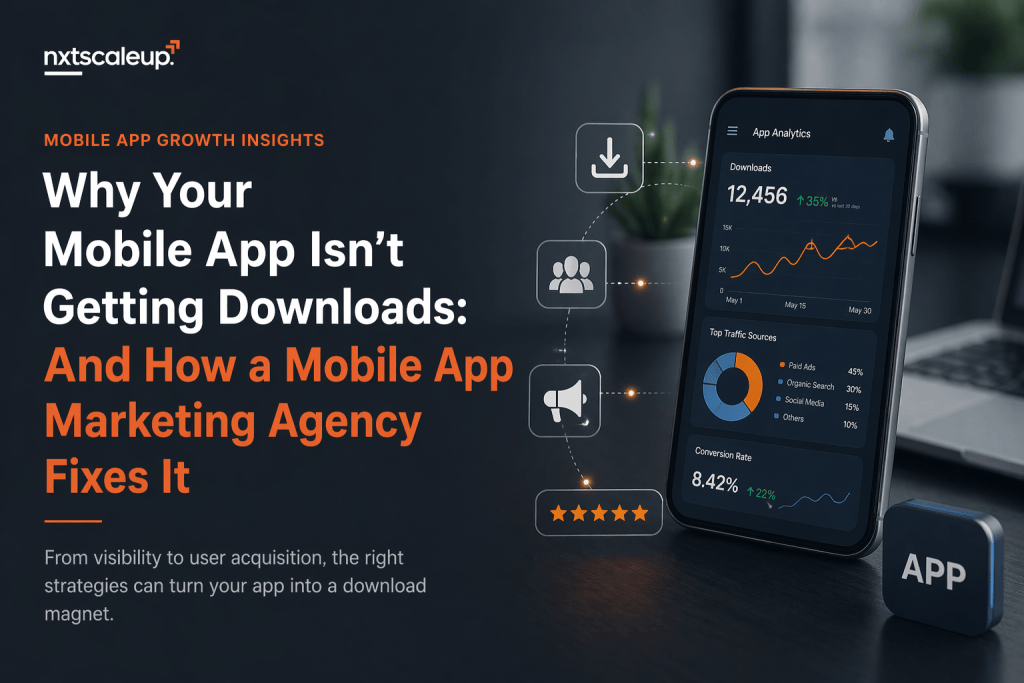
Why Your Mobile App Isn’t Getting Downloads: And How a Mobile App Marketing Agency Fixes It 

You’ve worked on your mobile app for months, maybe even years. The code is well-written, the user interface is nice, and the problem it solves is real. You launch on the App Store and Google Play and wait for the “hockey stick” growth curve to start, but all you hear are digital crickets.  The global app market is more crowded than ever in 2026. There are millions of apps competing for your attention, so just being “good” isn’t enough anymore. You’re not the only one whose downloads aren’t going up. Most developers fail not because of their product, but because they can’t get it out there. This is where a mobile app marketing agency comes in to connect a great product with a lot of users.  In this guide, we’ll talk about the most common mistakes that apps make when they try to grow and how an agency can fix them with data.  1. The “Invisible App” Problem: Poor App Store Optimization (ASO)  Apps often fail to get popular because people can’t find them. More than 65% of all downloads come from people who search for apps directly in the App Store and Google Play. Your app might as well not exist if it doesn’t show up in the top three results for the keywords you want to target.  How a Mobile App Marketing Agency Fixes It:  An agency doesn’t just “guess” at what words to use. They perform rigorous app store optimization(ASO) by:  2. Lack of a Coherent App Marketing Strategy  A lot of developers think of marketing as a series of “bursts,” like posting on social media or spending a little money on ads. This broken-up method doesn’t have the compounding effect needed for mobile app growth.. You might be wasting money on channels that don’t convert if you don’t have a North Star.  What a Mobile App Marketing Agency Does to Fix It:  A professional agency makes a complete app marketing strategy that includes the whole user journey:  3. Inefficient App User Acquisition (UA)  Paid ads are the quickest way to get users, but they also use up your money the quickest. Your business model won’t work if your Cost Per Install (CPI) is higher than the Lifetime Value (LTV) of your user.  How a Mobile App Marketing Agency Fix this:  Agencies focus on getting high-performance app user acquisition. They don’t just “run ads.” They engineer them.  4. High Churn: The “Leaky Bucket” Problem  If 1,000 people download your app but 900 of them delete it within the first 24 hours, you don’t have a marketing problem; you have a retention problem. However, retention is an important part of mobile app growth.  How a Mobile App Marketing Agency Fixes It:  A mobile app marketing agency checks the data to find out where users are leaving.  5. Ignoring the Power of Influencers and PR  In a time when AI makes a lot of noise, trust between people is the most important thing. People need to be talking about your app for it to have the “social proof” that makes people trust it with their data and phone storage.  How a Mobile App Marketing Agency Fixes it:  Agencies use their existing relationships with:  The ROI of a Mobile App Marketing Agency  Hiring an agency is an investment, but not hiring one can cost you more in the long run. It can cost tens of thousands of dollars in wasted ad money and lost time during the “trial and error” phase of app marketing. An agency gives you a quick way to find out what works, based on data from dozens of past launches.             

Digital Transformation
blog

Why Digital Transformation is the Prerequisite for Scalable Performance Marketing 

By 2026, in the business landscape chasing growth isn’t just about ambition, it’s become a technical game. For companies across Africa, especially those exploring digital transformation South Africa, the question isn’t whether to go digital, but how quickly they can get there.  Lots of brands go all-in on performance marketing strategy Africa, throwing big budgets at LinkedIn or Google and expecting a flood of new revenue. But if you don’t have your digital house in order, that just leads to wasted money, sky-high customer acquisition costs, and a mess of useless data. Right now, digital transformation for businesses Africa isn’t some fancy upgrade. It’s the groundwork every business needs before trying to scale their marketing.  1. The Intersection of Transformation and Performance  To understand why digital transformation matters in 2026 is the actual engine that runs the show, while performance marketing is just the fuel you pour in. If your engine’s old and broken, top-quality fuel won’t help, you’ll end up on the side of the road.  Digital transformation swaps out clunky, manual systems for an automated, data-driven setup. When we talk about scaling marketing with technology it’s about ditching spreadsheets and hunches for a real marketing technology stack Africa that gives you live insights and control. That’s what actually lets you scale.  The “Messy Marketing” Trap  Without transformation, your marketing turns into a mess. Leads come in from one source, get checked somewhere else, then somehow make it to sales,  if they don’t fall through the cracks first. With workflows like that, it is impossible to run a truly effective performance marketing strategy Africa, because you can’t see what’s working or track how an ad click becomes a signed deal.  2. Pillar 1: The Unified Data Infrastructure  The first real step toward digital transformation South Africa is pulling all your data together. By 2026, data isn’t just helpful—it’s everything. But honestly, data alone doesn’t do much unless everyone can find it and trust it.  Breaking Down Silos  Most businesses in Africa still work in their own bubbles. Marketing chases clicks, sales follows up with leads, finance tracks revenue, and none of them are really on the same page. Digital transformation for businesses Africa breaks down these walls by using a “Single Source of Truth.”   3. Pillar 2: Automation and Operational Efficiency  The speed of business in 2026, especially in Kenya, Nigeria, and South Africa is a major reason why digital transformation matters 2026. The window to turn a lead into a customer gets smaller all the time.  Speed-to-Lead  If someone grabs a whitepaper from your website, they want to hear from you in minutes, not days. Scaling marketing with technology is all about letting automation handle the boring stuff:  Through digital transformation consulting africa, businesses can spot where things slow down and swap out those manual steps for automated workflows. That way, good leads don’t slip through the cracks.  4. Pillar 3: Building a Marketing Technology Stack for Africa  Putting together a marketing technology stack Africa isn’t the same as in Europe or the US. You have to keep mobile devices, data costs, and local payment systems in mind.  The Essentials of a 2026 Stack  Think of this stack as the nerves running through your whole performance marketing strategy Africa. It lets you shift strategy on the fly, based on real-time data—not on reports that are already old news by the time you read them.  5. The Role of Digital Transformation Consulting Africa  A lot of CEOs are scared of the idea of a complete overhaul. Digital transformation consulting Africa is very important here. You don’t have to change everything at once; you just need a plan.  We design things at Nxtscaleup. We don’t just “run ads”; we help you set up the digital tools that will make those ads work. We look at your current “Messy Marketing” and make a plan for digital transformation South Africa that will help your business grow in a way that is scalable and predictable.  The Transformation Checklist:  Conclusion: Scaling into the Future  Companies that see technology as the foundation of their strategy, not an expense, will be the ones that rule Africa in 2026 and beyond. Businesses in Africa can only go from “Guesswork” to “Growth” by going through a digital transformation for businesses Africa.  When you invest in the right marketing technology stack Africa and stick to a structured roadmap, you’re not only improving your marketing, you’re also making your whole business future-proof. Stop fighting with “messy” systems and start building the engine that will turn your brand awareness into real, scalable income.  FAQ Find Out Answers Here Is digital transformation only for large enterprises? Not at all. In fact, scaling marketing with technology it’s often easier for small and medium-sized businesses because they are more flexible. For a small business, transformation could just mean switching from paper records to a cloud-based CRM and automating how they respond to new leads.  What is the biggest challenge of digital transformation in South Africa? Change Management is often the hardest part. It’s not just about the tools; it’s also about changing the way people think about data. Digital transformation consulting Africa is so important because it gives teams the advice they need to adjust to new ways of working.  How long does it take to see results from a digital transformation project? A full change can take 12 to 18 months, but you can see “Quick Wins” in as little as 90 days. Fixing your tracking or automating your lead-capture forms can give your performance marketing strategy in Africa a quick boost.  Can I run performance marketing without digital transformation? You can, but it won’t be very effective. You will probably have a lot of “lead leakage,” bad attribution, and a “ceiling” on your growth that you won’t be able to break until you upgrade your infrastructure.  Why can’t I see an estimated value of my project? A combination of unique data, industry expertise and analytical precision has made PropTrack a trusted leader

B2B vs. B2C Growth Strategies:
blog

B2B vs. B2C Growth Strategies: Navigating the Hybrid Landscape in Nigeria and Kenya

In 2026, the gap between business procurement and personal buying feels slimmer than ever. In West and East Africa especially in Nigeria and Kenya companies aren’t just debating B2B vs B2C marketing strategy Africa. The real challenge is figuring out how to blend both approaches seamlessly.  From what we’ve seen as a B2B marketing agency Nigeria, the strongest brands always remember one thing: at the end of the day, they’re talking to real people. Still, there’s a huge difference between convincing a fintech founder in Lagos and reaching a shopper in Nairobi. Navigating this mix isn’t simple, you need a Kenya digital marketing strategy that speaks the language of both the boardroom and the everyday home. That’s where brands really stand out now.  1. The Core Divergence: Relationship vs. Reach  If you want to build a solid growth engine in Africa, you need to know the difference between enterprise vs consumer marketing Africa. Let’s break it down.  The B2B Landscape: Trust as Currency  The B2B scene in Nigeria runs on trust. That’s just how it is. When a company hunts for a B2B marketing agency Nigeria, no one cares about flashy ads. What actually matters? Finding a strategic partner who knows their way around complicated power structures and endless approvals.  The B2C Landscape: Speed and Frictionless Experience  B2C digital marketing kenya 2026 it’s a different world. Everything’s about speed and how smooth you make things. Kenyan consumers basically live on their phones, and they expect fast, easy experiences.  2. Navigating the Hybrid Landscape: The B2B2C Model  For many marketing for tech companies Nigeria, are blending their marketing approaches. Take a fintech startup: they’ll pitch their platform to banks (B2B), but they’re also chasing everyday users with a wallet app (B2C). That’s why hybrid marketing strategy isn’t just a nice-to-have, it’s critical.  The Integrated Architecture  In a hybrid setup, your marketing has to split its focus. On one hand, you want a strong, credible presence on LinkedIn to get banks interested. On the other, you need lively, social content to draw in people who might actually use your app.  3. Kenya Digital Marketing Strategy: The Mobile-First Consumer   B2C digital marketing Kenya 2026 looks completely different—almost everything happens through social commerce now. People don’t just browse products online anymore. They want to check out what’s on offer, buy it, and even get support, all in the same chat app, like WhatsApp.  Key Growth Levers in Kenya:  4. B2B Marketing Agency Nigeria: Dominating the Digital Boardroom  Nigeria still dominates the continent’s B2B scene, but the “old way” of doing business relying on endless physical meetings, cold calls just doesn’t work anymore. Modern marketing for tech companies Nigeria,, you’ve got to lead with digital relationships.  Strategies for the Nigerian Enterprise Market:  5. Bridging the Gap: Performance Marketing for Both  Whether you’re executing a B2B vs B2C marketing strategy Africa, the heart of it all is still Performance Marketing.  At Nxtscaleup, we’re all about what the numbers show. For B2C brands in Kenya, we focus on driving down Cost Per Acquisition. For B2B brands in Nigeria, we zero in on Cost Per Qualified Lead. The full-funnel mindset means that, in the end, what we really care about is real business growth, tangible results.  Why Attribution Matters in 2026  These days, you just can’t get away with messy data. You need to know if the consumer who saw your B2C campaign turned out to be the decision-maker who closed a big B2B deal. That kind of data intelligence sets a strategic growth partner apart from your average agency.  6. Case Study Logic: B2B vs B2C in Practice  The Solar Tech Example.  Imagine a company like Wetility.  FAQs  Q1: What’s the biggest difference between B2B and B2C marketing in Africa?  It’s all about who makes the call. In B2C, you’re just talking to one person. In B2B, you’re facing a group—people who care less about feelings and more about lowering risks and seeing real returns.  Q2: Is LinkedIn effective for B2C marketing in Nigeria?  Sometimes. Linkedin is the best channel for high-ticket B2C, like luxury homes, private banking, or executive education. But if you’re aiming for the average consumer, mass-market B2C, Instagram, TikTok, and WhatsApp work way better.  Q3: How do I manage a hybrid marketing strategy without doubling my budget?  Make your content stretch further. Want to reach both types of customers? Start with a detailed B2B whitepaper about “Energy Efficiency.” Slice it up into punchy, fun TikTok videos for B2C. By reusing your research, you get a lot more out of every dollar.  Q4: Why is a specialized Kenya digital marketing strategy necessary for 2026?  Kenya’s all about mobile money and trust circles. Generic global strategies flop there. You have to meet people on WhatsApp and make sure everything’s smooth on a phone. If you don’t, you’re just not going to connect.  Q5: Can a B2B marketing agency in Nigeria also handle B2C?  Absolutely. As long as they focus on full-funnel growth, it translates pretty well. The main building blocks using data to target the right people, tracking what’s working, and pushing for conversions aren’t limited to one type of client. Sure, selling to an individual is different from selling to a company’s decision-maker, but with the right team, one that understands how buyers think in both worlds, it works.  Conclusion: Mastering the Hybrid Engine  If you want to win at the B2B vs B2C marketing strategy Africa, you need more than a flashy campaign. Growth comes from a system, layered strategy, sharp data, and performance that actually moves the needle. Whether you’re running a tech startup in Lagos or building a consumer brand in Nairobi, your mission is simple: turn attention into real revenue.  Ready to build out your hybrid growth? Reach out to Nxtscaleup for a deep dive into your funnel, we’ll help you lay the groundwork for serious growth by 2026. 

Messy Marketing
blog

Moving Beyond “Messy Marketing”: How to Architect a 12-Month Growth Roadmap 

In the fast-paced business scenes of Nigeria, Kenya, South Africa, and the GCC, there’s a problem holding back even the boldest companies: messy marketing.  It’s more than just a lack of good ideas. It’s a deep-rooted issue. You see it in scattered campaigns, data that never talks to each other, and teams always scrambling for quick fixes instead of building real, long-term systems. If businesses want to grow for real by 2026, they have to ditch the chaos and work from a clear, structured marketing plan for SMEs, one that turns growth into something methodical, not just hit-or-miss luck.  That’s where a solid, 12 months digital marketing plan comes in. It’s not just paperwork. It ties your business goals to the tools you need, turning brand awareness into steady revenue you can actually count on.  1. Why You Need a Marketing Roadmap for Businesses in Africa  Emerging markets don’t play by the same rules. Between fluctuating currencies in Nigeria, Nairobi’s tech scene is launching a wave of new competition, and the sophisticated corporate environment of Johannesburg, a “business as usual” approach is insufficient. If you are struggling with how to fix disorganised marketing, the real problem is friction.   You get friction when your marketing tools can’t sync, when salespeople don’t trust the leads you provide, or when nobody, especially your CEO can’t see how your marketing spend is paying off. A strategic marketing roadmap for businesses in Africa is your solution. Here’s what changes:  2. Phase 1: The Infrastructure Audit (Months 1-3)  Whenever we consult on how to create a marketing strategy in South Africa or the GCC, we don’t rush into running ads. We focus on the basics first, “the plumbing”. Think about it like this: if your bucket has holes, it doesn’t matter how much water you dump in, it’ll never fill up.  Fixing the “Messy” Foundation  The first three months of your 12 months digital marketing plan really need to tackle digital transformation. Start by looking hard at your tech stack. Is everything actually set up to guide a customer from their very first click all the way to the final sale,is it full-funnel ready?  3. Phase 2: High-Intent Acquisition (Months 4-6)  After the infrastructure’s in place, it’s time for Phase 2: Performance Marketing. This stage is all about figuring out which channels really move the needle for your business.  Strategic Channel Selection  A lot of brands spread themselves too thin, trying to show up everywhere at once. A structured marketing plan for SMEs leans on the 80/20 rule, find that small slice of channels that actually bring in the bulk of your revenue.  Launching the “Awareness to Revenue” Bridge  In this next part of your digital marketing planning in 2026, we roll out lead magnets, think whitepapers or diagnostic tools. These aren’t about chasing clicks. They give people something valuable, and they give you direct insight into who actually wants to connect. You get real data to work with, not just empty traffic.  4. Phase 3: The Optimization Engine (Months 7-9)  By month seven, you’ve probably gathered enough data to spot where things still slow down in the funnel. This is where the “Middle of the Funnel” work kicks in.  Fixing the “Vetting” Issue    In industries like Fintech or Solar, not all leads are worth your time. If your sales team keeps getting bogged down with the wrong prospects, growth just hits a wall.  5. Phase 4: Scaling & Retention (Months 10-12)  The last quarter of your 12-month digital marketing plan is when things get exciting. This is where you take all the momentum from a strong campaign and use it to turn your business into a true leader in the market.  Maximizing LTV (Lifetime Value)  Let’s talk about squeezing as much value as possible out of every customer. It’s five times cheaper to keep someone coming back than to win over someone new. Any decent marketing strategy template in Africa or anywhere, honestly needs a plan for engaging people after they buy.  Aggressive Scaling  At this stage, you know how much you pay to land a customer, and you know how well your conversion funnel works. So go ahead and raise your budget with confidence. This isn’t guesswork anymore you’re investing, and you can predict the payoff.  Nxtscaleup Difference: Architecture Over Tactics  A lot of growth marketing agencies love to promise quick hacks. But let’s be honest those hacks don’t hold up when currencies drop or platforms switch things up.  At Nxtscaleup, digital strategy is our backbone for digital marketing planning in 2026. We treat your 12-month digital marketing plan as something alive, constantly adjusting to what’s really happening in African and GCC markets. Ditching what we call “Messy Marketing” isn’t just about making your ads look better. It’s about creating a smart, resilient engine that brings in revenue automatically, around the clock.  Conclusion: How to Start Your Growth Journey  If you’re a Founder, CEO, or Head of Marketing and you feel like your strategy is all over the place, don’t just throw more ad money at the problem. You need a structured marketing plan for SMEs, one that focuses on building a solid foundation before anything else.  With the right marketing roadmap for businesses in Africa, you go from guessing what’s next to knowing exactly where your next lead comes from. The uncertainty fades, and instead, you get to focus on serving all the new customers your well-oiled marketing machine brings in.  Is your business ready for a 12-month transformation?  At Nxtscaleup, we help companies across Africa turn brand awareness into actual revenue. Contact us today for a strategic diagnostic of your current roadmap and let’s start building your growth engine for 2026.  FAQ Find Out Answers Here What is “messy marketing”? Messy marketing refers to reactive, unstructured campaigns that lack clear goals, consistency, or long-term planning often leading to wasted budget and inconsistent results.   Why is a 12-month growth roadmap important? There is no limit to the number of properties you can track. Once you have tracked a property you will be able to track additional properties, make changes to your property relationship and change your primary property. What are the key components of a growth roadmap? It typically includes defined goals (KPIs), target audience insights, channel strategy, content planning, budget allocation, and a timeline for execution and optimization.   How can businesses transition from messy marketing to structured planning? Start by auditing current efforts, identifying gaps, setting clear quarterly goals, and implementing systems for tracking performance and accountability.   How

Conversion Rate Optimization
blog

Conversion Rate Optimization Agencies Boost African Brand Sales: The 2026 Growth Guide 

In the digital world of 2026, African entrepreneurs are facing a hard lesson: just getting traffic is no longer enough. You can pour money into social media ads and search engine tricks, watch the visitor numbers go up, and still end up with nothing to show for it when nobody actually buys anything. It feels like throwing cash straight into the pockets of Big Tech.  Across Lagos, Nairobi, or Johannesburg, you will see the same story everywhere: a flood of people land on local e-commerce sites, but only a handful end up making a purchase. African e-commerce growth is booming, but high bounce rates and weak sales funnels are holding brands back. That’s where conversion rate optimization (CRO) agencies come in. They’re obsessed with a simple idea: how do you turn all those site visitors into real customers? For a lot of African businesses, these agencies are becoming their not-so-secret weapon to drive real, lasting African brand sales growth.  I. What Is Conversion Rate Optimization and Why Does It Matter in Africa?  Conversion Rate Optimization (CRO) is all about boosting the share of your website visitors who actually do something you want, make a purchase, sign up, fill a form.   Pretty simple math for any African business owner: get 1,000 people to your website and convert just 1%? You’ve got 10 sales. But if you work with a CRO services Africa and nudge that rate to 2%, suddenly you’ve doubled your sales without spending a dime more on ads.  African vs. Global Benchmarks  Globally, e-commerce sites usually see conversion rates of 2.5% to 3%. African sites, though, often don’t even hit 1%. It’s not because African consumers aren’t interested. Most of the time, users experience in Africa run into issues like slow loading on mobile, confusing menus, or payment methods they just don’t trust. That “bad” website you’ve got? It’s more expensive than any employee. It turns away money every single day.  II. How Conversion Rate Optimization Agencies Work  A professional conversion rate optimization agency doesn’t rely on guesses, they dig into the numbers. Here’s how they tackle a broken digital sales funnel:  1. Website and Landing Page Audits  They always kick things off by combing through your data. The goal? Find out exactly where people bail. Is it the product page that loses them? Or maybe the shipping selection? With landing page optimization, they make sure the first thing visitors see actually grabs them and gives them a reason to stick around.  2. A/B Testing and User Behavior Analysis  A/B testing Africa, this is where they start experimenting. Agencies test two versions of a page, maybe one with a green “Buy Now” button and one with a red. Or they pit a long checkout form against a shorter one to see what makes people convert.  3. Heatmaps and Session Recordings  They use heatmaps to track every click, scroll, and hover. And with session recordings, they can watch (completely anonymously) how someone in Accra, for example, gets lost hunting for the “Add to Cart” button on their phone.  4. Mobile Experience Optimization for Africa  Most Africans go online with their phones, so online store optimization Africa needs to work smoothly on mobile. That means sites need to look good on small screens, be easy to use with one hand, and use lightweight images that don’t eat up data or stall out on 3G.  5. Checkout and Payment Flow Optimization  The truth is, checkout is where most sales fall apart in Africa. Agencies fix this by connecting to popular local payment methods like Paystack, Flutterwave, or M-Pesa, and by stripping out any unnecessary steps, making it easy for customers to finish their purchase without hassle.  III. How CRO Agencies Are Boosting Sales for African Brands  Turning Existing Traffic Into Paying Customers    CRO agencies in Africa care about one thing: getting more out of what you already have. Instead of pouring money into more clicks, they work to squeeze more value from the visitors already finding your site. This sharpens your return on ad spend without extra advertising costs.  Reducing Cart Abandonment    Let’s be honest, nothing kills a sale faster than hidden fees or skyrocketing shipping costs at checkout, these are enemies of African brand sales growth. CRO pros fight this by rolling out progress bars, “save for later” buttons, and totally upfront pricing. The result? Fewer drop-offs and more shoppers actually buying.  Building Trust Signals    Getting people to trust your brand online isn’t easy, especially in many African markets. That’s why agencies scatter trust-builders like verified reviews, secure payment icons, and no-nonsense return policies exactly where folks get nervous or unsure.  Improving User Experience (UX)   If it takes more than three clicks to find something, people don’t stick around. Localized CRO teams work to smooth out these bumps in user experiences in Africa. They clear away confusion and make sure the road from homepage to checkout feels simple, natural, and, honestly, almost automatic.  IV. What to Expect When Working With a CRO Agency   The Timeline  Don’t expect miracles overnight. Sure, agencies can clean up some easy problems fast, but real, data-driven changes take a few months, say, three to six, to really show up.  Metrics and KPIs   Bounce Rate: Are people sticking around or fleeing right away?    Add-to-Cart Rate: How many visitors actually start buying something?    Customer Acquisition Cost (CAC): Are new buyers getting cheaper to win over?  V. Top Industries in Africa Benefiting From CRO Agencies   VI. How to Choose the Right Agency for Your African Brand   Key Questions to Ask:  Red Flags:  Conclusion: Transform Your Visitors into Buyers  Africa’s digital scene isn’t just about spending more on ads it’s about who makes it easier for customers to buy. Conversion rate optimization agencies protect your marketing budget and help turn your website into a real growth machine.  Your visitors are on your site already. Give them that last nudge to say “yes.”  Don’t let a clunky site waste your traffic. Want to boost your revenue? Book a free CRO audit with us

B2B & B2C Enterprises
blog

The 2026 Full-Funnel Growth Playbook: Scaling B2B & B2C Enterprises in Emerging Markets

In the current economic climate of 2026, chasing growth at any cost doesn’t work anymore. Especially for companies in Nigeria, Kenya, South Africa, and the GCC, the focus has shifted. It’s not just about getting noticed, it’s about making revenue more predictable.  At Nxtscaleup, we know real growth isn’t something you stumble on with one great ad or a viral campaign. It takes a real system. You need digital strategy, data intelligence, and performance marketing working together. This playbook is your guide to building a full-funnel marketing strategy in 2026, one that actually turns brand awareness into real business results.  I. Why Modern Growth is a System, Not a Silo  A lot of businesses in emerging markets deal with messy, scattered marketing. They’re running ads on Meta, posting on LinkedIn, firing off cold emails, yet when you ask which effort landed them their last customer, they’re not really sure.  A real growth marketing agency does more than push ads out into the world. We build a system. Here’s how it works:  Put these three pieces together, and you stop experimenting in the dark. You finally see what’s fueling real results, and that’s when growth really picks up.  II. The Full-Funnel Architecture: From Awareness to Revenue  If you want to build a winning enterprise marketing strategy, you’ve got to really know your customer’s journey, especially when things change fast.  Awareness: Capturing Intent  In 2026, it takes more than just racking up likes or impressions. For a B2B Strategy, you need to be the expert everyone notices in those online boardrooms. For a B2C marketing strategy in Nigeria 2026, it’s all about being present where people are actually talking be it on LinkedIn, WhatsApp, you name it. We aim our performance marketing in emerging markets toward decision-makers with real intent, not just anyone who happens to scroll by.  For B2B Strategy  For B2C Strategy  III. Middle-of-Funnel (MOFU): The Trust & Nurture Gap  Consideration: Solving the “Messy Middle” This is the tricky part, the “messy middle” where most companies lose out. From the moment someone clicks to when they buy, things can get clogged up with manual work and scattered data. That’s where a smart digital growth agency comes in. We tighten up those leaky spots, set up streamlined systems, think automated lead screening, strong CRM links, and personal follow-ups so no one slips away before becoming a customer.  Here’s where most businesses drop the ball when trying scaling business in emerging markets: they spark interest, but then just let it fizzle out.  A digital growth agency in 2026 takes a different approach.   IV. Bottom-of-Funnel (BOFO): Conversion & Friction Removal  Conversion: Realizing Revenue This is where your entire full funnel marketing strategy 2026 gets put to the test. You want that moment where someone decides to buy, whether you’re selling solar gear like Wetility or the latest fintech solution, to be as smooth as possible. It’s all about syncing marketing data with real sales action, so every handoff feels seamless and simple.  In emerging markets, getting customers to convert is all about overcoming technical obstacles. If you want your 2026 full-funnel marketing strategy to work, you need to focus on what happens right at the end, “The Final Mile” , that last hurdle before someone actually makes a purchase.  Essential 2026 Conversion Tactics:  V. Post-Purchase: Retention & The Viral Loop  In 2026, your most affordable customer is the one you’ve already got. If you are looking at scaling enterprise marketing, you’ve got to turn those existing customers into your best engine for growth.  VI. The Tech Stack for Emerging Market Growth  To run a full funnel marketing strategy 2026, your growth team or growth marketing agency should be leveraging a modern “Growth Stack”  Component  2026 Standard  Function  CRM  Agentic CRM (e.g., HubSpot + AI Agents)  Managing the B2B sales pipeline and B2C data.  Attribution  Multi-Touch Identity Resolution.  Tracking a user across WhatsApp, Web, and Offline.  Automation  Omnichannel Flow Builders  Triggering the right message on the right app.  Analytics  Predictive LTV Models  Knowing which markets (e.g., Ghana vs. Nigeria) are most profitable.  VII. Scaling Business in Emerging Markets: The 2026 Nuance  Scaling business in emerging markets like Ghana, Rwanda, or the GCC isn’t as simple as copying what works somewhere else. You need someone on the ground who really gets how things work.  The Nxtscaleup Advantage: Turning Intelligence into Action  We’re a performance-led growth marketing agency focused on real results. Our approach to data analytics & intelligence ensures that every decision made is backed by a “Source of Truth.” We go beyond sending reports, we deliver insights you can actually use. We ensure every move you make stands on solid facts.  We replace “messy” manual reporting with automated dashboards that give you total visibility over your Customer Lifetime Value (LTV) and Acquisition Costs.  Conclusion: Are You Ready to Scale?  The difference between a brand that survives and a brand that dominates in 2026 is the quality of its infrastructure. If you are a Founder, CEO, or Head of Marketing looking to move past fragmented campaigns and build a unified revenue engine, it’s time for a different approach.  Nxtscaleup is your strategic growth partner. Let’s stop running campaigns and start building your growth engine. Book a strategy call today.  FAQ Find Out Answers Here Why is a full-funnel strategy better than just running ads? Running ads by themselves drains your budget fast, and people tend to ignore them. When you have a full-funnel strategy, every time you pay to get someone’s attention, you actually follow up, nurture them and push for conversion, so you end up bringing in customers for less money.  How does a B2B strategy differ in emerging markets versus the West? In emerging markets, doing B2B business is really about personal connections. Sure, digital tools help you get started, but when it’s time to actually close a deal, local trust matters most. That means having local offices, local numbers people can call, and success stories from the area, not just a slick online pitch.  Is a growth marketing agency necessary for SMEs? If you’re an SME trying to scale fast, handling all the channels, tracking what’s working, and integrating AI on your own turns into a mess. Agencies with experience keep you from burning through your budget just figuring things out.  What is the biggest trend in B2C marketing strategy Nigeria 2026? Nigeria’s heading toward “WhatsApp-ification” of commerce. Basically, if your marketing doesn’t flow straight into simple, direct conversations, like chatting on WhatsApp, you’re leaving

Marketing Attribution
blog

How a Marketing Attribution Company Can Help African SMEs Stop Wasting Ad Spend 

By 2026, digital advertising in Africa is a fierce game. Nairobi’s buzzing tech scene and Johannesburg’s massive retailers are both pouring serious money into Facebook Ads, Google Search, and TikTok campaigns. But there’s a real problem behind the scenes: wasted ad spend. It’s bleeding out of businesses, quietly but quickly.  The numbers are tough to ignore. Almost 40% of what African SMEs ad spend goes straight down the drain, these campaigns get clicks, sure, but not a single sale. The worst part? Most business owners can’t even tell which ad led to a real customer. They’re operating in the dark, guessing what works and hoping for luck.  That’s where marketing attribution companies come in. It isn’t just another tool, it’s the difference between guessing and knowing. With proper attribution, suddenly you’re not wasting money on clicks that go nowhere. You’re putting every dollar where it matters.  This guide breaks down how leaving the guesswork behind, and really seeing which performance marketing drive results, can turn your whole business around.  I. The Ad Spend Problem Facing African SMEs Today  The Rising Cost of Digital Advertising in Africa  Digital advertising across Africa isn’t cheap anymore. As more global brands jump into the scene, the cost-per-click (CPC) on big platforms has shot way up. It wasn’t that long ago when it made sense for small businesses to run ads in places like Lagos or Accra, they could reach people without breaking the bank. Now? It feels like you need deep pockets just to play. For small or midsize businesses, every single Naira, Shilling, or Rand is critical.  The Attribution Blind Spot  Here’s where a lot of African SMEs trip up: they’re stuck on “vanity metrics.” Maybe your campaign gets 10,000 clicks, but if your sales didn’t budge, those clicks meant nothing. The real problem is that people don’t follow a straight path to buy from you. Someone might catch your ad on Instagram, then read a review somewhere, and only buy later after searching for you on Google. If you only focus on the last ad that landed the sale, you’ll end up turning off the Instagram ad that sparked the whole journey, and that just kills your funnel.  The Impact on Growth  Spending money on ads that don’t bring results isn’t just a simple loss. That’s money you could’ve invested in more inventory, new hires, or building better products. If you want your business to grow, inefficient ad spend optimization holds you back, period.  II. What a Marketing Attribution Company Actually Does  This is where a marketing attribution company steps in. They use tech and know-how to map out every move a customer makes with your brand before they finally buy. Basically, they answer that big question: “Which of our marketing efforts actually led to this sale?”  Types of Attribution Models  To really get value from your marketing data in Africa, you’ve got to pick the right attribution model:  First-Touch Attribution: All the credit goes to the first ad a customer clicked. It’s handy for seeing what grabs new people’s attention, but misses out on everything that turned that first spark into a sale.  Last-Touch Attribution: All credit goes to the last click before someone buys. It’s simple, but it ignores all the behind-the-scenes work that built up trust and interest.  Multi-Touch Attribution (MTA): This is what most pros rely on for performance marketing. It spreads credit across every step along the way. If a customer saw three ads before buying, you’ll see how much each one mattered.  A good marketing attribution company can set up multi-channel attribution for you, so you actually see the bigger picture of how your customers find and choose you. That’s how you make every marketing dollar or Naira, or Shilling, or Rand work a lot harder.  III. How Attribution Helps African SMEs Stop the Bleed  Working with an attribution partner gives your business four clear advantages:  1. Identifying “Real” Customer Sources  Let’s face it, not all website traffic is equal. Attribution pulls back the curtain so you can actually tell if your expensive LinkedIn ads are attracting serious clients, or if all that “affordable” Facebook traffic is just bots and people misclicking.  2. Eliminating Underperforming Campaigns  With solid marketing data, you see exactly which ads are burning cash without bringing in sales. Axing these flops frees up your budget and bumps up your profits right away.  3. Reallocating Budget to High-Performers  Imagine you find out every $1 spent on YouTube brings in $5, but Twitter only returns $0.50. A good marketing attribution company makes it easy to shift your money from Twitter to YouTube, so your returns skyrocket, no extra spending needed.  4. Improving Overall ROI  The whole point of ad spend optimization is to make your marketing spend smarter. Instead of just throwing money at ads, you’re building a system for reliable, predictable growth.  IV. Key Features to Look for in a Marketing Attribution Company  Not all agencies or software work well in Africa. Here’s what matters:  V. Industries in Africa Where Attribution Is Making the Biggest Impact  Industry  Why Attribution Matters  Key Metric to Track  E-Commerce  High volume of small transactions across multiple social platforms.  Cost Per Acquisition (CPA)  Fintech  Long journey from “seeing an ad” to “opening an account” and “funding it.”  Life Time Value (LTV)  Retail/FMCG  Bridging the gap between online ads and in-store foot traffic.  Online-to-Offline Conversion  EdTech  High consideration period where customers need multiple “touches” before buying.  Lead-to-Enrollment Rate  Conclusion: Take a Data-First Approach  Let’s be real: If you’re running digital advertising in Africa, the companies who win are the ones who treat marketing like a science experiment, not a shot in the dark. Keep running ads without knowing what’s working, and you’ll burn through your cash with nothing to show for it.  But when you team up with a marketing attribution company, you finally see what’s driving results, and what’s dragging you down. You can optimize African SMEs ad spend, and make a real run at leading your market. The data’s already there. You just need someone to help you understand it.  It’s time to stop guessing and start growing. Want to know where your money is really going? Reach out now for a free attribution audit and take charge of your ad spend.  FAQ Find Out Answers Here What is a marketing attribution company and what do they do? A marketing attribution company gives you the tools and advice you need to figure out which marketing channels, ads, or keywords

Data Analytics
blog

How Data Analytics Can Drive Business Growth in Africa: Top Services for Success 

In 2026, the African continent is no longer just a “frontier market” it is a digital powerhouse.. The AfCFTA connects over 1.5 billion people as one huge market, and now, having better insights matters more than raw resources. Still, here’s what’s surprising: even though digital adoption is booming, less than a third of African companies really dig into their data to make their businesses run better.  For many entrepreneurs in Lagos, Nairobi, Johannesburg, and Cairo, decisions are still made based on “gut feeling” or historical patterns that no longer hold true in a fast-paced, post-AI world. This guide digs into how Data Analytics Services in Africa are changing the game. They take all that raw information, sift through it, and turn it into real business growth in Africa. If you want to scale up by 2026, data-driven decision making isn’t just an option, it’s essential.  I. Why Data Analytics Matters for African Businesses  The High Cost of Guesswork  Guessing comes with a steep price. In an unpredictable economy, one bad call, maybe you buy too much stock for your shop, or you pick the wrong customer to give credit to can sink your business. Bottom line: relying on gut feels burns through cash, snarls up supply chains, and leaves you blind to what your customers really want.  The Global vs. Local Gap  Now, look at what’s happening in Africa. Big names like Amazon, Netflix, and Unilever are crushing it here, not because they throw money around, but because they nail the details. They use advanced business intelligence in Africa, and they get local habits, sometimes better than homegrown businesses do. These giants seem to know what a shopper in Accra wants before that person even hops online.  So where does that leave local small and mid-sized businesses? Honestly, if they want to stand a chance and win back market share, they can’t just guess anymore. Local SMEs need proper data consulting services to catch up and compete. That’s what closes the gap.  II. Top Data Analytics Services Driving Business Growth in Africa  If you want to achieve business growth in Africa and keep it sustainable, you need to focus on a few key analytical tools. Here’s what leading companies are doing:  1. Business Intelligence (BI) Reporting  This is where it all starts when it comes to data-decision making. BI tools like Power BI and Tableau allow business owners to see their entire operation in real-time dashboards. No more waiting for stacks of paper at month’s end, you can check in on sales, cash flow, and even how your team’s performing, all in real time.  2. Customer Behavior Analytics  Getting to know the African consumer isn’t about guesswork. Companies now use data to break down who’s buying, when, and how things like spending patterns, mobile habits, and peak shopping hours. That way, your marketing hits just the right people at just the right moment.  3. Sales and Revenue Analytics  Instead of just eyeballing past sales, dig into the data. Figure out which products barely move and which ones customers love. These days, you can go further, model pricing to find that perfect spot: high enough for profit, low enough so customers don’t go elsewhere, even when money’s tight.  4. Social Media and Digital Marketing Analytics  With Africa being a mobile-first continent, your digital footprint is your storefront. Analytics let you see exactly what you’re getting from every ad dollar, shilling, or rand not just empty likes, but real sales. That means your budget actually works for you.  5. Predictive Analytics for African Markets  This is where data consulting services really shine. By tapping into AI, predictive models help businesses in Africa look ahead like estimating Kenya’s next harvest, tracking currency swings in Nigeria, or spotting a jump in demand for solar panels in South Africa.  III. Industries in Africa Benefiting Most From Data Analytics  Industry  Primary Data Use Case  Impact on Growth  Fintech & Banking  Credit scoring & fraud detection  Expands access to loans for the unbanked.  Retail & E-Commerce  Inventory & supply chain optimization  Reduces waste and prevents “out of stock” issues.  Agriculture  Yield prediction & weather tracking  Increases food security and farmer profits.  Healthcare  Patient outcome tracking & resource allocation  Saves lives through efficient medicine distribution.  Telecommunications  Churn prediction & network optimization  Improves customer retention in competitive markets.  IV. How to Choose the Right Data Analytics Service  Hiring a main Africa is more than just ticking a box, it’s a smart move for any business that wants to grow. But, let’s be real, finding the right provider takes some work.  Questions to Ask a Potential Partner:  In-House vs. Outsourced Analytics  Go in-house only if you’re a big player, such as a bank or telecom, and you handle mountains of data every day.   Outsourcing is usually the way to go. With a consulting firm, you get a bench of data scientists and engineers for less than it would cost to hire one junior analyst.  Budget Considerations  For most African SMEs in 2026, a basic business intelligence setup sits between $500 and $2,000 a month. If you’re eyeing the fancy stuff, predictive AI modeling for big business? That’s $10,000 or more. Don’t get overwhelmed; start small. Fix your dashboards, clean your reporting. The AI magic comes later.  V. Real-World Results: Data-Driven Success Stories  In Nigeria, a mid-sized retailer ran customer analytics and found out 40% of their shoppers wanted weekend evening deliveries. They shifted their schedule—bam, customer retention shot up 25%.  In Kenya, an agritech startup used predictive analytics to help 50,000 small farmers know the best time to plant, tracking shifting rainfall. Their average yields jumped 15%.  In South Africa, a fintech company rolled out real-time fraud detection, blocking scams before they happened and saving R50 million just in the first quarter of 2026 Conclusion: The Future belongs to the Informed  In the business intelligence Africa landscape of 2026, data is pure potential, but you need a way to turn all those numbers into useful insights. That’s what marketing analytics agencies do, they’re your