blog

Marketing Budget
blog

Why “Last Click Wins” Is Killing Your Marketing Budget

If you’re still crediting all your revenue to the last ad someone clicked before they bought, you’re not measuring your marketing you’re guessing. And that guess is probably costing you a significant chunk of your budget every single month. “Last-click attribution” is the default setting in almost every analytics platform, from Google Analytics to Facebook Ads Manager. It’s simple, it’s built-in, and it feels intuitive: the customer clicked this ad, then bought, so this ad gets the credit. The problem is that real customer journeys rarely work this way and when you optimize your budget around a broken model, you end up starving the channels that actually build your pipeline while overfunding the ones that simply show up at the finish line. What “Last Click Wins” Actually Means Last-click attribution assigns 100% of the credit for a conversion to the final touchpoint before purchase, usually a paid search ad, a retargeting banner, or a branded search click. Every other interaction the customer had with your brand along the way gets zero credit. Picture a typical journey: Under last-click attribution, that final branded search ad gets 100% of the credit. The Instagram ad, the SEO content, and the email campaign the touchpoints that actually built awareness, trust, and intent get nothing. On paper, it looks like branded search is your best-performing channel. In reality, it was just the last domino to fall. Why This Quietly Destroys Marketing Budgets 1. You overinvest in “closing” channels and underinvest in “opening” channels. When branded search, retargeting, or email look like your top performers, it’s tempting to shift budget toward them and cut spend on top-of-funnel channels like social media, content, and PR. But those top-of-funnel channels are often what created the demand in the first place. Starve them, and your “high-performing” bottom-funnel channels eventually run out of people to convert. 2. You can’t tell the difference between demand creation and demand capture. Paid search and retargeting are demand-capture channels that catch people who are already looking to buy. Content, social, and PR are demand-creation channels that build the audience that eventually searches for you. Last-click attribution can’t distinguish between the two, so it consistently rewards capture over creation. 3. You make decisions on incomplete data. Most last-click setups also ignore cross-device journeys, offline touchpoints, and multi-session research behavior which is especially common in markets across South Africa, Nigeria, Kenya, and Ghana, where customers frequently browse on mobile, compare on desktop, and convert days or weeks later. If your model can’t see that journey, you’re optimizing blind. 4. It creates internal conflict and bad incentives. When teams or agencies are measured on last-click conversions, they naturally chase the cheapest, fastest wins, usually branded search and retargeting rather than investing in the slower, harder work of building genuine brand demand. Over time, this shrinks the top of the funnel and quietly increases customer acquisition costs, even while last-click “performance” looks stable. The Real Cost: A Simple Example Say a business spends R50,000 a month across Instagram ads, SEO content, email marketing, and branded paid search. Last-click attribution shows branded search converting at a low cost per acquisition, so the team doubles that budget and cuts Instagram and content spend to fund it. Three months later, branded search volume starts declining because fewer people are discovering the brand in the first place. The “best” channel is now converting fewer people, not because it got worse, but because the channels feeding it were defunded. This is one of the most common and least visible ways marketing budgets get eroded: not through overspending, but through misallocation based on incomplete data. What Should Replace It The fix isn’t to abandon last-click reporting entirely; it’s still useful for certain bottom-funnel decisions. The fix is to layer in a model that reflects the full customer journey: None of these require a data science department to implement well. What they require is a properly structured CRM, clean tracking across your funnel, and a marketing partner who actually builds attribution into the strategy rather than treating it as an afterthought. How Nxtscaleup Approaches This This is exactly the gap Nxtscaleup was built to close. As a full-funnel growth marketing agency working with brands across South Africa, Nigeria, Kenya, Ghana, and Rwanda, Nxtscaleup doesn’t treat attribution as a reporting exercise bolted on at the end of a campaign; it’s built into how strategy and budget decisions get made from day one. That works because Nxtscaleup operates across the entire funnel rather than a single channel in isolation: By connecting attribution data directly to CRM and conversion data, Nxtscaleup helps brands see the real path customers take and reallocates budget toward the channels doing the actual work of building demand, not just the ones standing closest to the checkout button. The Bottom Line Last-click attribution isn’t wrong because it’s simple, it’s wrong because it’s incomplete, and incomplete data leads to confidently wrong decisions. If your reporting only shows you the last domino, you’ll keep funding the fall and defunding the push. Fixing your attribution model isn’t just a data project, it’s one of the highest-leverage changes you can make to how your marketing budget actually performs.
Marketing Attribution
blog

Marketing Attribution as Part of a Bigger Digital Transformation Strategy

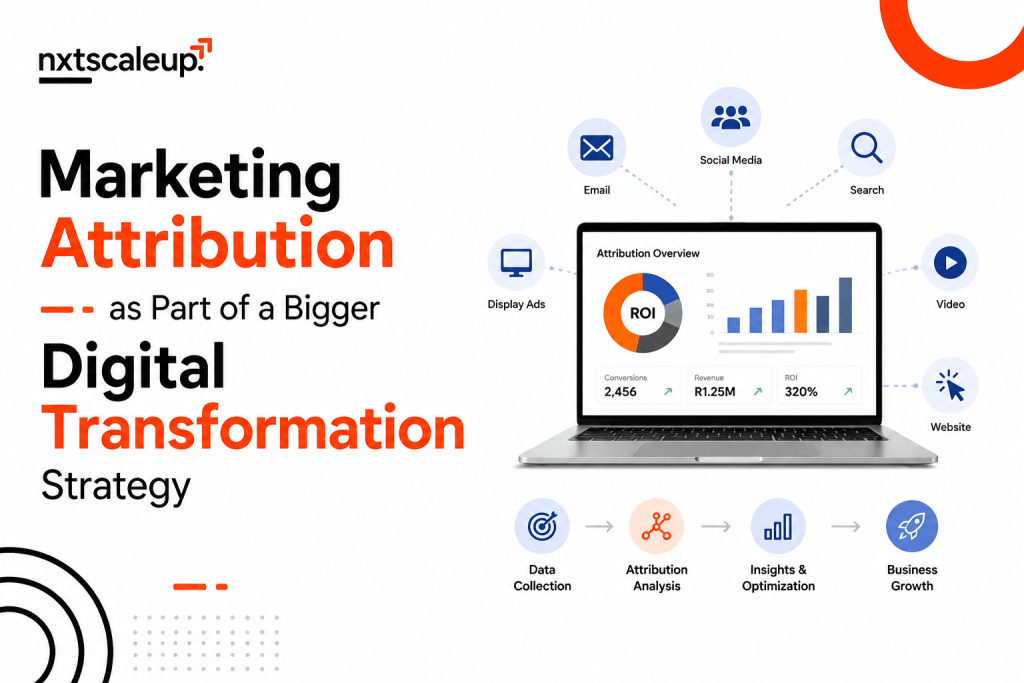
Most businesses treat marketing attribution as a reporting exercise: a dashboard you check at the end of the month to see which channel gets the credit for a sale. But attribution, done right, isn’t just about assigning credit. It’s about understanding the entire customer journey well enough to make faster, smarter decisions across your whole business. And that’s exactly why attribution can’t live in isolation. It has to be part of a bigger digital transformation strategy. If you’re scaling a business in South Africa, Nigeria, Kenya, Ghana, or Rwanda, you already know the market moves fast, budgets are tight, and every rand or naira spent on marketing needs to earn its place. That’s where connecting attribution to a broader transformation strategy changes everything. What Marketing Attribution Actually Solves At its core, marketing attribution answers one deceptively simple question: which of your marketing efforts actually led to a sale? The problem is most businesses answer that question badly. They rely on last-click attribution giving 100% of the credit to whichever channel the customer interacted with right before converting. That means if someone saw your Instagram ad, read a blog post, opened three emails, and then clicked a Google search ad before buying, only the search ad “wins.” Everything else that built trust and pushed them down the funnel gets ignored. This creates a dangerous feedback loop. Marketing teams pour more budget into the channels that look good on paper (usually paid search or retargeting) and starve the channels doing the real work of building brand awareness and nurturing leads. Over time, this doesn’t just waste money, it actively slows growth. Proper attribution models first-touch, multi-touch, and data-driven models give you a fuller picture. But even a great attribution model is only half the story. The other half is what you do with that data, and that’s where digital transformation comes in. Why Attribution Needs to Live Inside a Transformation Strategy Digital transformation isn’t just about adopting new tools or moving processes online. It’s about rebuilding how a business makes decisions using data, systems, and strategy that talk to each other instead of operating in silos. Here’s the disconnect that happens in most growing companies: marketing has its own dashboards, sales has its own CRM, and finance has its own spreadsheets. Attribution data sits in a marketing tool nobody outside the marketing team ever opens. Meanwhile, the CRM shows which leads actually became paying customers, but that information rarely makes its way back into marketing’s understanding of channel performance. When attribution is built as part of a genuine digital transformation strategy, these systems are connected. Marketing attribution data feeds into the CRM. CRM data feeds back into how campaigns are optimized. Finance can see, in real time, which channels are actually producing revenue, not just leads or clicks. This is the difference between having data and having a system that uses data to drive growth. At Nxtscaleu, this is the foundation of how we work with growing businesses across Africa. We don’t treat marketing attribution as a standalone service it’s one part of a connected approach that spans Performance Marketing (SEO, paid social, email, app marketing, PR), Data & Analytics (CRM strategy, conversion rate optimization, and marketing attribution itself), and Digital Strategy (digital transformation and growth consulting). Attribution is the layer that makes the other two pillars measurable, and digital strategy is what turns those measurements into action. The Business Case: Why This Matters More Than Ever For founders and marketing leads, the pressure to prove ROI has never been higher. Ad costs are rising across nearly every platform. Investors and stakeholders want to see efficient customer acquisition, not just growth at any cost. And customer journeys have become more fragmented. People move between mobile apps, social platforms, search, email, and offline touchpoints before ever making a purchase decision. Without a transformation strategy tying attribution to the rest of the business, companies end up making three costly mistakes: 1. Optimizing for the wrong metrics. Teams chase leads or clicks instead of revenue, because that’s what their disconnected attribution tool shows them. 2. Duplicating effort across teams. Sales and marketing argue about which leads are “good” because they’re working from different data sets. 3. Missing the compounding value of brand-building channels. Content, PR, and social media rarely get credit in simplistic attribution models, so budgets shift entirely toward direct-response channels even when those brand-building efforts are quietly driving a large share of conversions. A connected digital transformation strategy fixes this by making sure every team is looking at the same data, interpreted the same way, tied back to the same business goals. What This Looks Like in Practice When we work with clients on this, the process typically follows a few key stages: Audit and unify the data. Before you can attribute anything correctly, you need clean, connected data. This means auditing your CRM, ad platforms, website analytics, and sales pipeline to make sure they’re tracking consistently and talking to each other. Choose the right attribution model for the business. Not every company needs a complex multi-touch model. A local service business might do fine with a simpler model, while an e-commerce or fintech brand with a longer sales cycle needs something more sophisticated. This decision should be based on sales cycle length, average deal size, and how many channels are actually in play. Connect attribution insights to conversion optimization. Once you know which channels and touchpoints matter most, that data should directly inform where you focus conversion rate optimization efforts landing pages, email sequences, retargeting flows, and more. Feed insights into broader strategy. This is the step most businesses skip. Attribution data shouldn’t just adjust ad spend, it should inform product positioning, sales messaging, market expansion decisions, and even hiring priorities for growth teams. Build for ongoing iteration. Digital transformation isn’t a one-time project. Markets shift, platforms change their algorithms, and customer behavior evolves. Attribution needs to be revisited regularly as part of an ongoing growth strategy, not set once and

Search vs. Social: Where to Allocate Your Growth Budget for Maximum ROI in Rwanda 
blog

Search vs. Social: Where to Allocate Your Growth Budget for Maximum ROI in Rwanda 

By 2026, Rwanda’s digital world isn’t some “future opportunity” it’s a busy battlefield. Internet use has exploded not just in Kigali, but across Musanze, Rubavu, and other cities. So business leaders are stuck with the digital marketing budget allocation Africa dilemma: Should you put your money behind SEO vs social media marketing Rwanda the smarter move?  Here’s what’s real. You might be a fintech founder launching a new app, or a CEO running a traditional service-based business looking to grab more customers. No matter what, your marketing budget Africa 2026 only stretches so far. If you put it in the wrong channel, you aren’t just wasting money, you’re probably handing your competitors a big head start.  Let’s break it down, This guide provides a clinical breakdown of how to choose the best marketing channel Rwanda for your specific business goals, moving from initial awareness to final installation or sale.  I. The Great Debate: SEO vs. Social Media Marketing Rwanda  First things first, know your customers. Search and social aren’t just “different channels”, they’re different ways people think.  1. The Power of Intent: SEO and Google Ads  Picture someone typing “agence seo Rwanda” or “best insurance Kigali” into Google. They’re not just browsing; they want answers and solutions.  2. The Power of Discovery: Social Media Marketing  Social media in Rwanda (Facebook, Instagram, TikTok) are where people stumble onto new stuff. No one’s hunting for your business; they’re just scrolling.  II. Strategic Budget Allocation: A 2026 Framework  There’s no magic “50/50” split—it depends on your business.  Case A: The Service-Based Business (Lawyers, Solar, Logistics)  For services, search should be your main play.  Case B: The Consumer Brand or Startup (Fintech, E-commerce, Apps)  For new products, social comes first.  III. The Role of a Professional SEO Agency Rwanda  Plenty of businesses in Rwanda ignore SEO, but in 2026, you can’t afford to. Search engines now rely on Generative Engine Optimization (GEO). A modern agency SEO Rwanda isn’t just changing meta tags, they’re building your authority, making sure AI-powered search engines (Google Gemini, Perplexity, etc.) put your site at the top.  What to Expect from Top-Tier SEO in Kigali:  IV. Capturing ROI: How to Track the Journey  Don’t make your digital marketing budget a guessing game, The biggest mistake in marketing budget Africa 2026 is not having an attribution model. If you spend 1 million RWF on Facebook, you need to know did it actually drive sales?  V. Key Trends for Rwanda in 2026  Find Out Answers Here Which is better for a small business in Kigali: SEO or Social Media? If you’re short on cash and want quick results, start with Facebook and Instagram. But if you want long-term, “free” leads, you’ll need to invest in SEO agency Rwanda to build organic reach.  How much should I allocate to my digital marketing budget Africa 2026? Rwandan SMEs should aim for 5% to 10% of revenue on marketing. If you’re in hyper-growth mode (launching, scaling), go as high as 20%.  Google Ads vs Facebook Ads Africa: Which has a better ROI? For urgent services like plumbers or lawyers, Google Ads wins. For visual products, lifestyle brands, or anything with an app download, Facebook Ads pull ahead.  What should I look for in a professional agency SEO Rwanda? Look for agencies focused on real results: leads and revenue, not just website traffic. Ask for proof, actual case studies ranking tough Rwandan keywords.  Can I do SEO and Social Media marketing at the same time? Absolutely, and honestly, you should, it’s called omnichannel strategy. Social builds the buzz; SEO makes sure you’re found when users are ready to buy.  Why is my social media marketing Rwanda not getting sales? Probably because your content is too generic. Likes and views don’t equal sales, your digital marketing budget allocation Africa is missing a “Conversion” layer. Add clear calls-to-action and use simple, smooth landing pages.  How long does it take to see results from an SEO agency Rwanda? SEO is slow but steady. Expect 3 to 6 months to see real ranking gains, sometimes a bit longer in highly competitive markets. 

Performance Marketing
blog

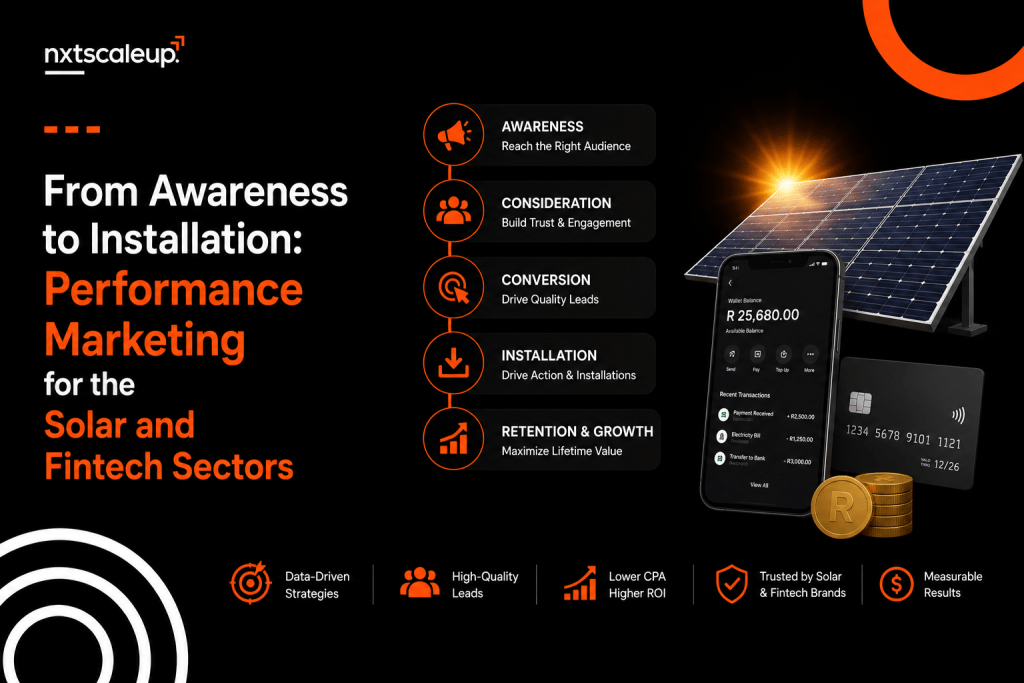
From Awareness to Installation: Performance Marketing for the Solar and Fintech Sectors

Looking at the economic landscape in 2026, it’s pretty clear, solar energy and fintech are the two big drivers in emerging markets. On the surface, they seem totally different. One’s about putting hardware on rooftops, the other is just data in the cloud. But there’s a real link between them: both need consumers to trust them, and the journey from first interest to actually installing a solar system or activating an app is far from easy.  If you’re working in these industries, just running ads won’t cut it anymore. Making real progress means shifting to a performance marketing fintech and solar framework that leans heavily on data and the unique quirks of these sectors. So, let’s dig into how these sectors overlap and how you actually get people from “Hmm, maybe” to “Alright, sign me up.”  The Convergence of Solar and Fintech  You may not see it straight away, but these sectors really feed off each other. In places like South Africa, solar energy marketing only picks up steam because finance steps in. Let’s be honest, a solar system isn’t cheap. If companies skip out on fintech digital marketing, like flexible “solar-as-a-service” or buy-now-pay-later deals, most homeowners just won’t bother.  Performance marketing isn’t just about clicks in 2026. It’s all about managing the cost per acquisition across a complicated, multi-step customer journey.  1. Top of Funnel: Building High-Intent Awareness  You can’t just make noise and hope people show up. Awareness needs to teach, not just tell.  Solar Marketing Strategy: Education First  In solar marketing strategy, oftentimes people don’t get the true costs of solar or how long batteries really last. Top-of-funnel content should focus on:  Fintech Digital Marketing: Solving the “Pain”  With fintech digital marketing, awareness works when you spell out all the pain points, ridiculous fees, slow transfers, bad credit options. Make video ads that hit home with those who feel left out by the banking system.  2. Middle of Funnel: Lead Generation and Trust Building  Awareness is good, but you need solid leads, where your goal shifts to fintech customer acquisition and solar leads generation South Africa.  Solar Leads Generation in South Africa  South Africans are desperate for reliable energy. But they’re also wary of dodgy installers. So, your marketing needs to scream credibility:  Performance Marketing Fintech: The Trust Gap  In app marketing fintech, getting people to link their bank account to a new app? Tough. So don’t rush the sign-up. Invite them to webinars or let them download a free security guide first. Small wins, then the big ask.  3. Bottom of Funnel: From “Click” to “Installation”  This is where things get real, here “marketing” meets “operations”  The Solar Installation Hurdle  Leads don’t mean sales. The biggest revenue gap in solar energy marketing is between a filled-out form and actually getting panels installed. To fix that, marketing teams need to:  App Marketing Fintech: The Onboarding Sprint  In app marketing fintech, app downloads aren’t conversions, what matters is that crucial first transaction.  4. Measuring Success: The 2026 Marketing Data Stack  To run a successful performance marketing fintech, you need one clear source of truth for all your marketing data.  5. Strategic Challenges and Opportunities  Regulatory Hurdles  Both sectors are heavily regulated. Fintech digital marketing has to comply with financial laws like the (FSCA in South Africa) while solar marketers need to keep tabs on changing tariffs.  Identity Resolution  Third-party cookies are dead. So, to keep up, fintech brands’ customer acquisition have started building their own first-party data which includes their own communities, think newsletters, WhatsApp groups, member portals to keep track of users.  Conclusion: The New Growth Paradigm  If you want to win at performance marketing fintech and solar energy marketing in 2026, don’t just be technical, be empathetic. You’re asking people to rethink how they power their homes and how they handle their money. Huge deal.  A full-funnel approach teaching first, making conversion seamless doesn’t just lower acquisition costs. It sets you up for steady, long-term growth.  Find Out Answers Here What is the difference between brand marketing and performance marketing in fintech? Brand marketing’s about general awareness and share of voice. Performance marketing fintech gets down to brass tacks: app installs, account sign-ups, successful KYC, and ROI tracking.  How long does it take to see results from solar leads generation in South Africa? You can get leads within 48 hours, but getting actual installs (and money in the bank) needs 4 to 12 weeks. There are site visits, audits, and finance checks to get through.  What are the best channels for app marketing fintech in 2026? TikTok and YouTube Shorts rule for awareness. Apple Search Ads and Google UAC still deliver for high-intent actions.  Why is CRM integration so important for fintech digital marketing? Without it, you’re flying blind. Cheap installs mean nothing if people don’t deposit money. CRM lets you aim your ads at users with real lifetime value, not just anyone who downloads an app. 

full-Funnel LinkedIn Ads: A Guide for Founders and CEOs in South Africa
blog

Full-Funnel LinkedIn Ads: A Guide for Founders and CEOs in South Africa 

Full-Funnel LinkedIn Ads: A Guide for Founders and CEOs in South Africa  In South Africa’s 2026 business scene, trust and relationships mean everything. So, the old “spray and pray” approach to digital marketing is gone. These days, founders and CEOs aren’t just fighting for attention, they’re trying to reach the right people at exactly the right moment, and those folks need to have real influence.  Lots of companies throw money at boosted posts, but hardly anybody nails a full-funnel LinkedIn advertising strategy in South Africa. Here’s how you can go from basically invisible to absolutely essential, using the world’s top B2B platform.  I. The Strategic Case for LinkedIn in the South African Market  South Africa isn’t your average B2B market. It’s a “Gateway to Africa,” so B2B LinkedIn marketing in South Africa here often hits decision-makers across the SADC region and even further afield.  Why Founders Must Lead the Charge  Being faceless in 2026 is bad news. Buyers want to know who’s behind the brand. When CEOs and founders are visible on LinkedIn, it puts a human face on the business. LinkedIn ads let you scale that connection. Instead of betting on organic reach, you can guarantee your best ideas land on the desks of that JSE-listed exec you’ve been hunting down for months.  The “Dark Social” Reality  Deals in South Africa usually start in WhatsApp groups, private messages, and old-school word of mouth. A full-funnel LinkedIn strategy means that when someone mentions your name in these circles, others already recognize you from seeing your valuable content via Linkedin ads in South Africa.  II. Level 1: The Top of the Funnel (Awareness)  Goal: Get recognized as an expert, even before prospects realize they need help.  Right now, you’re selling a perspective, not a product. Most LinkedIn advertising strategy South Africa flop because they try to book a meeting too early. You have to earn the “Ask.”  High-Impact Awareness Tactics:  III. Level 2: The Middle of the Funnel (Consideration)  Objective: Trade meaningful insight for contact info.  Now people know your name. Time to figure out who’s actually interested. LinkedIn lead generation in South Africa here has to get tactical.  The Lead Magnet Strategy  Generic whitepapers don’t work. To grab a lead, deliver something with real local relevance.  IV. Level 3: The Bottom of the Funnel (Conversion)  Goal: Turn digital connections into actual sales.  This stage is crucial for B2B LinkedIn marketing in South Africa. You’re targeting the “Hand-Raisers” folks who’ve watched your videos and grabbed your downloads.  Retargeting: The ROI Multiplier  Don’t show “Book a Demo” ads to people who have never heard of you. Instead, retarget to show high-intent ads only:  Conversational Ads  Forget the old school InMail. In 2026, “Conversation Ads” rule. Prospects get a menu: “See Case Study,” “Get Pricing,” or “Talk to a Consultant.” They pick what works for them.  V. Technical Execution: Navigating LinkedIn Campaign Manager South Africa  Getting the settings right makes or breaks your campaign. When learning how to run LinkedIn ads in Africa, founders often fall into the “Automated” trap.  1. Manual Bidding  LinkedIn pushes “Maximum Delivery” (automated bidding), but manual lets you control your cost per click. That way, you avoid blowing money on low-quality traffic.  2. Insight Tag Implementation  You cannot track LinkedIn lead generation in South Africa effectively without the Insight Tag. Install this code snippet if you want to track who visits your site. It shows you the demographic (company, job title, location) of everyone, even if they don’t fill out a form.  3. Audience Expansion: Use with Caution  “Audience Expansion” can weaken your targeting. If you want to reach CEOs in Sandton, you don’t want interns seeing your ad just because they follow the same hashtags. Keep your targeting focused.  VI. Measuring Marketing ROI: Beyond Vanity Metrics  If you’re a CEO, likes mean nothing. You care about how to track marketing ROI.  The Metrics That Matter:  VII. Why You Might Need LinkedIn Ads Consulting  LinkedIn is complicated and expensive to get wrong. Lots of South African companies hire Linkedin ads consulting to:  Find Out Answers Here How much should a South African SME spend on LinkedIn ads? To see meaningful results, start at R15,000–R25,000 per month. Lower budgets usually don’t provide enough data for the algorithm to optimize.  What is the best ad format for LinkedIn ads for founders? Thought Leader Ads. Posts from founders’ profiles outperform company page ads in both engagement and cost per lead.  How do I target specific companies (Account-Based Marketing)? Upload a CSV of your “Dream 100” companies into Linkedin Campaign Manager South Africa. LinkedIn matches those and shows ads only to decision-makers at those firms.  Is LinkedIn advertising strategy South Africa different from the US or UK? Yes. The market is smaller and connections matter more. Localize your copy, think load shedding, compliance, and the unique “Saffa” business vibe. Don’t just copy global templates.  How long does it take to see a return? South African B2B cycles take time. You could get leads week one, a full B2B LinkedIn marketing South Africa strategy usually takes 3 to 6 months to show a clear ROI in terms of revenue.  Can I run ads in other African countries from South Africa? Sure. How to run LinkedIn ads in Africa is a centralized process. You can run LinkedIn ads in Lagos, Nairobi, or Cairo from your SA Campaign Manager. Just adjust currency and messaging for those regions.   

Social media icons and management theme
blog

Social Media Management South Africa in 2026: How to Build a Brand, Drive Engagement & Turn Followers into Paying Customers

South Africa has one of the most socially connected populations on the African continent. With over 25 million active social media users, platforms like Facebook, Instagram, TikTok, LinkedIn, and X (formerly Twitter) have become the primary spaces where South African consumers discover brands, form opinions, make purchasing decisions, and share experiences with their networks. For businesses, this represents an extraordinary opportunity and a significant challenge. The opportunity is access. Never before in the history of marketing have businesses of every size had direct, continuous access to their target customers at zero media cost. The challenge is noise. Millions of businesses are competing for the same attention, and the platforms themselves are making organic reach increasingly difficult for brands that treat social media as an afterthought. Professional social media management in South Africa in 2026 is what separates businesses that are genuinely building brand equity, community, and revenue through social channels from those spending hours creating content that disappears into the feed without result. This guide breaks down everything South African businesses need to understand about social media management services, social media marketing, and the broader advantages of digital marketing as a growth engine. What Social Media Management Actually Means in 2026 There is a persistent misconception in the South African business market that social media management means posting regularly and responding to comments. While consistency and community engagement are essential components, professional social media management is a far more strategic discipline. Modern social media management encompasses platform strategy, audience research, content planning, copywriting, graphic design, video production, community management, paid amplification, influencer coordination, analytics interpretation, and continuous optimization  all working together toward specific, measurable business outcomes. The distinction matters because businesses that treat social media management as a content scheduling exercise consistently underperform compared to those that treat it as a strategic marketing function. In 2026, the platforms reward depth of engagement, content quality, and audience relevance above all else. Gaming algorithms with volume alone no longer work. Professional social media management services in South Africa structure their work around three core objectives that correspond to the customer journey: building awareness among people who have never heard of your brand, nurturing consideration among people who know you but have not yet committed, and driving conversion among people who are ready to buy or engage. Every piece of content, every campaign, every platform decision should serve one of these three objectives clearly. The South African Social Media Landscape: Platform by Platform Understanding which platforms South African consumers actually use and how they use them  is the foundation of any effective social media strategy. Not every platform is right for every business, and spreading resources thinly across all platforms is one of the most common and costly mistakes South African businesses make. Facebook Despite global narratives about Facebook losing relevance among younger demographics, Facebook remains the largest social media platform in South Africa by user volume. It is particularly dominant in the 25 to 45 age bracket, a demographic with significant purchasing power  and remains the primary platform for community building, event promotion, local business discovery, and detailed targeted advertising. Facebook’s advertising infrastructure is the most sophisticated of any social platform, offering granular targeting by location (down to radius from a specific address), demographics, interests, behaviours, life events, and custom audience matching against your existing customer database. For South African businesses running paid social campaigns, Facebook and its integrated Instagram advertising platform frequently deliver the strongest return on ad spend across most consumer categories. Instagram Instagram has become the primary visual brand-building platform for South African businesses targeting consumers between 18 and 35. Its format  images, carousels, Reels, and Stories rewards businesses that invest in visual identity and creative quality. In 2026, Reels continue to receive disproportionate organic reach compared to static content, making short-form video production a core competency for any brand serious about Instagram growth. For South African businesses in categories like food and beverage, fashion, beauty, fitness, travel, interior design, and lifestyle, Instagram is frequently the single highest-priority social platform. The visual nature of the platform means that design quality is directly correlated with follower growth and engagement rates poorly designed content from a visually strong competitor is immediately obvious to the audience. TikTok TikTok’s growth in South Africa has been remarkable. Its algorithm is unique among major platforms in that it distributes content based on engagement quality rather than follower count, meaning a brand-new account with zero followers can achieve hundreds of thousands of views on a single video if the content genuinely resonates. This democratisation of reach has made TikTok the platform with the greatest organic growth potential for South African brands willing to invest in creative, authentic short-form video. The platform’s user base in South Africa skews younger, with particularly strong penetration in the 16 to 28 age bracket. But TikTok’s influence extends well beyond its direct users, content that performs on TikTok frequently migrates to other platforms, and TikTok trends consistently influence broader popular culture and consumer behaviour. For South African businesses, TikTok rewards authenticity, entertainment, and education far more than polished corporate content. Behind-the-scenes content, founder stories, product demonstrations, customer testimonials, and educational content in formats that feel native to the platform consistently outperform branded content that reads as advertising. LinkedIn LinkedIn is the dominant professional networking platform in South Africa and the primary social media channel for B2B marketing, professional services, recruitment, and thought leadership. For businesses targeting other businesses agencies, consultancies, technology companies, financial services providers, legal firms, logistics companies LinkedIn is frequently the highest-value social media channel in terms of lead quality. In 2026, LinkedIn’s algorithm rewards content that generates genuine professional conversation. Long-form posts that share genuine expertise, case studies that demonstrate real results, and founder-led content that offers authentic perspective on industry challenges consistently outperform promotional announcements and job postings. South African professionals are active LinkedIn users, and the platform’s targeting capabilities for B2B advertising by industry, job title, company size, and seniority  make it particularly powerful for

SEO Services in 2026
blog

SEO Services in 2026: The Complete Guide to Local, Off-Page & Online SEO for South African Businesses

The digital landscape in South Africa has shifted dramatically. With over 45 million internet users and mobile penetration surpassing 90%, businesses that fail to invest in professional SEO services are essentially invisible to their most valuable customers. Whether you run a boutique in Cape Town, a law firm in Johannesburg, or an e-commerce store serving all nine provinces, search engine optimization is no longer optional; it is the backbone of sustainable online growth. This guide breaks down every pillar of modern SEO services, explains what South African businesses specifically need in 2026, and shows you exactly how each service type translates into real revenue. What Are SEO Services and Why Do They Matter More Than Ever in 2026? SEO services are the professional strategies, technical implementations, and ongoing optimization efforts that help your website rank higher on Google and other search engines. When a potential customer searches for “best plumber in Pretoria” or “digital marketing agency Cape Town,” the businesses that appear on page one capture almost all the clicks and the revenue that follows. In 2026, the rules have evolved. Google’s AI-powered search experience, the rise of voice search, and hyper-local intent signals mean that yesterday’s tactics actively hurt your rankings today. What works is a layered, intent-driven approach that combines technical precision with genuine value for the searcher. The stakes are high. Studies consistently show that the first organic result on Google captures between 27% and 32% of all clicks. Position two drops to around 15%. By the time you reach page two, traffic falls to less than 1%. This is why professional SEO services not guesswork, not cheap link packages are what separate businesses that dominate their markets from those that struggle to survive. Local SEO Services South Africa: Dominating Your City and Suburb What Is Local SEO? Local SEO services focus specifically on helping your business appear when people search for products or services near them. In South Africa, this means showing up in the “map pack”  the three business listings that appear with a map at the top of Google  as well as in organic results for location-based queries. When someone in Sandton searches for “accountant near me” or “SEO agency Johannesburg,” local SEO is what puts your business in front of them at the exact moment they are ready to buy. Google Business Profile Optimisation Your Google Business Profile (formerly Google My Business) is the single most powerful tool in local SEO. A fully optimised profile includes accurate NAP (name, address, phone number) data, consistent business categories, high-quality images updated regularly, and a steady stream of genuine customer reviews. In 2026, Google weighs behavioural signals more heavily than ever. Profiles that receive regular photo uploads, frequent question-and-answer engagement, and consistent review responses outperform dormant profiles regardless of how good the website behind them is. Local Citation Building for South African Markets Citations are mentions of your business name, address, and phone number across directories and listing sites. For South African businesses, this means building and maintaining consistent citations across platforms like: Inconsistent citations — even small variations like “Rd” versus “Road” send conflicting signals to Google and suppress your local rankings. Professional local SEO services audit every existing citation, correct inconsistencies, and build new listings in relevant South African directories. Suburb and City-Level Landing Pages South African cities are vast. Johannesburg alone spans dozens of distinct commercial nodes Sandton, Rosebank, Midrand, Fourways, Soweto. Cape Town covers the CBD, the Atlantic Seaboard, the Southern Suburbs, and the Winelands. A single “Contact Us” page does not capture local intent at this granular level. Professional local SEO services create optimised, uniquely written landing pages for each service area you want to rank in. These pages address the specific needs, terminology, and buying behaviour of customers in each location, dramatically expanding your footprint in Google’s local results. Review Generation and Reputation Management Google’s local algorithm treats reviews as a trust signal. Businesses with more reviews, higher average ratings, and active owner responses consistently outrank competitors with fewer or older reviews. A structured review generation strategy including follow-up processes, QR codes, and email sequences turns satisfied customers into a continuous ranking advantage. Off Page SEO Services: Building Authority That Google Cannot Ignore What Is Off-Page SEO? Off-page SEO services refer to everything that happens outside your website to influence your rankings. While on-page SEO tells Google what you do, off-page SEO tells Google that you are trustworthy, credible, and authoritative. In 2026, this is primarily built through link acquisition, digital PR, and brand signal development. Strategic Link Building Backlinks links from other websites pointing to yours  remain one of Google’s most important ranking factors. Not all links are equal. A single link from a respected South African news publication or industry body is worth more than hundreds of links from irrelevant or low-quality sources. Professional off-page SEO services focus on acquiring links that are: For South African businesses, this means targeted outreach to local news sites, industry publications, business associations, and high-traffic lifestyle and commerce platforms operating within the country. Digital PR and Brand Mentions Modern off-page SEO is inseparable from PR. When your business is featured in respected South African media Business Day, Fin24, IOL, Daily Maverick, regional business journals  Google registers those mentions as powerful trust signals. Even unlinked brand mentions contribute to what Google understands as your entity authority. A well-executed digital PR strategy positions your business as a credible voice in your industry, generates high-authority backlinks as a by-product, and drives direct referral traffic alongside the SEO benefit. Competitor Backlink Analysis One of the most effective strategies in off-page SEO is understanding exactly where your competitors are earning their authority. By analysing the full backlink profiles of businesses ranking above you, professional SEO services identify specific link opportunities you can pursue publications that have covered your competitors and would likely cover you, directories you haven’t listed in, and content formats that attract links in your space. Social Signals and Brand Authority While social media

CRM and Marketing
blog

Building a “Source of Truth”: Integrating CRM and Marketing Stacks for Full Visibility 

In the 2026 digital-first economy, data isn’t just a bonus for businesses, it’s the fuel that keeps everything running. But for a lot of companies, that data sits locked away in separate corners of the business. Marketing tracks clicks and leads, while Sales cares about contracts and conversions. The two teams barely talk, at least not through their data.  This disconnect gets even messier when scaling business in emerging markets. Here, customer journeys zigzag across mobile devices, and every touchpoint matters because high data costs mean you need to make every impression count. If you try to grow with scattered spreadsheets and patchwork systems, you’ll hit a wall. The solution? Move everything into one clear, connected marketing system, a single source of truth marketing model..  Once you nail seamless CRM integration marketing, you can finally bridge the gap between people who know your brand and the folks who actually buy from you. So, how do you build a modern marketing data stack South Africa that works for businesses in Africa to ensure full visibility and steady growth starting right here?  I. The Cost of Fragmented Data  When your CRM and marketing stack don’t talk to each other, you bleed time and money. The “Fragmentation Tax” looks like this:  For Nigerian SMEs or big B2B companies, these blind spots are the main reason digital transformation grinds to a halt.  II. Building the Right Marketing Data Stack South Africa  Building a robust marketing data stack South Africa of the border requires a unique approach. You can’t just copy-paste what works in Silicon Valley for South African, the buyer journeys play by their own rules. Think WhatsApp for first contact, mobile money payments, and customers who don’t always have perfect internet.  A strong marketing stack in 2026 comes down to these three parts:  1. The Collection Layer (First-Party Data)  It’s all about first-party data. You need to collect information straight from your audience, think website analytics, lead forms, and WhatsApp chats.  2. The Integration Layer (The Glue)  This is where everything connects. Tools like Zapier or built-in APIs make sure that, say, when someone grabs a brochure, the CRM captures it right away. If you’re looking for the best CRM for Nigerian SMEs, make sure it connects easily with the rest of your tools.  3. The Analytics Layer (The Dashboard)  Here’s your control room. A good marketing analytics dashboard pulls in data from everywhere, marketing platforms and your CRM. Finally, you see the full story. You can answer: “Which LinkedIn post from Lagos actually landed that $50,000 deal?”  III. HubSpot vs. Salesforce: Choosing Your Engine  In 2026, the debate of HubSpot vs. Salesforce is heating up again. Both platforms have gone big on AI, but they approach things differently, so you really have to pick the one that fits how you work.  Feature  HubSpot (The Unified Choice)  Salesforce (The Modular Choice)  Philosophy  “All-in-one” platform with a shared database  Modular ecosystem with deep customization.  Ease of Use  High; designed for marketers to manage.  Medium; usually requires a dedicated admin.  Integration  Native and seamless across Hubs.  Powerful, but often requires third-party help.  Best For  Growing SMEs and Mid-Market firms.  Large Enterprises with complex field sales.  A lot of CRM tools for African businesses promise value, HubSpot’s Breeze AI and unified data model just get results faster. On the other hand, when you’re dealing with huge enterprises spread out across several countries, Salesforce’s Data Cloud is still the go-to for handling mountains of records without breaking a sweat.  IV. Steps to Achieving a Single Source of Truth  Chasing a single source of truth marketing isn’t only about picking the right software. You need to nail the process, too.  V. Emerging Trends: CRM Tools for African Businesses  By 2026, “Localized CRMs” have started to dominate. Best CRM for Nigerian SMEs now often includes;  Conclusion: Visibility is Your Competitive Advantage  The companies that will win over the next five years are the ones who see their whole customer journey, start to finish. Making your CRM and marketing stack work together isn’t just an IT upgrade, it’s a strategic game-changer.  Get your teams looking at the same data by building a single source of truth marketing, you empower your team to stop guessing and start growing with confidence. Swap the hope-and-pray tactics for a clear, proactive, data-driven approach that scales up smoothly.  Want to make it happen? Reach out for a digital growth audit—and let’s build your single source of truth.  FAQ Find Out Answers Here What is CRM integration marketing? It’s the process of linking your CRM with your marketing tools. You get a smooth, automatic flow of info between Marketing and Sales.  What are the best CRM tools for African businesses? Right now, HubSpot stands out for being simple and all-in-one. Salesforce rules enterprise setups. If you want customization (no code!), monday.com Sales CRM is a strong pick.  Why do I need a single source of truth marketing model? Without one, your data’s trapped in silos, everyone’s working off different numbers. With one set of accurate data, decisions get better, ROI goes up, and nobody’s guessing.  HubSpot vs. Salesforce: which is better for a 20-person team? For smaller teams, HubSpot wins. You won’t need a big budget or a full-time admin just to keep things moving.  How do I build a marketing analytics dashboard? Most CRMs include some reporting, but if you want the full picture, tools like Looker Studio or Power BI can bring data from everywhere, your CRM, ads, social, into one dashboard.  What is a marketing data stack South Africa? It means your marketing and data tools are built for the unique challenges of South Africa’s market: everyone’s on mobile, data costs are high, and you need things to just work.  Can a CRM help with lead scoring? Absolutely. With CRMs like HubSpot or Salesforce that integrate AI, it looks at engagement and tells Sales exactly who they should call first. 

Attribution Crisis:
blog

The Attribution Crisis: How to Track Revenue from LinkedIn DM to Final Contract 

B2B sales in 2026 feel like they’ve gone underground. The old public buying signals have faded into private Slack chats, encrypted WhatsApp threads, and most influential of all, the LinkedIn ecosystem. These days, it’s not unusual for a LinkedIn DM to kick off a deal worth millions.  There’s just one big problem: the attribution crisis, nobody knows where to give credit anymore.  Most companies are still stuck on outdated “Last-Click” attribution models. Imagine this: a buyer trades DMs with your CEO on LinkedIn, grabs a whitepaper a few weeks later, and then signs after clicking a Google ad. Most traditional analytics will give Google all the credit. That means your ads budget grabs more cash than it should, while the real sources of big deals like social connections, word-of-mouth, personal relationships, get ignored.  If you want your business to compete in the next wave of digital sales, you need to master how to track marketing ROI across the entire “Dark Social” universe. This guide goes deep into building a modern marketing attribution framework. Marketing attribution consulting is a key part here, it lets you connect a forgotten first message to a signature on a contract.  I. The Anatomy of the Attribution Crisis  Here’s the deal: revenue attribution B2B fails because the process isn’t linear far from it. Sure, we’d like to believe someone sees an ad, visits the site, and buys. But real B2B sales look more like a mess of interlocking threads.  Latest data from 2026 shows the average B2B deal includes 12 to 18 touchpoints and at least half a dozen decision-makers. Private LinkedIn messages are almost impossible for normal tracking software to catch, which means your CRM marketing attribution report isn’t seeing some of your most valuable moments.  II. Why Traditional “Last-Click” Models are Failing  Let’s be honest, most teams are operating like it’s 2015. They depend on last-touch attribution because it’s simple. But in the complex world of B2B, this gives a twisted view of reality:  III. The Solution: Moving to a Multi-Touch Attribution Model  Companies are moving into a multi-touch attribution model because it spreads credit across the entire buying journey. Instead of letting the final click take all the glory, each touch gets recognition based on impact.  1. U-Shaped (Position-Based) Attribution  This one’s a favorite starting point for LinkedIn marketing attribution focused teams. It hands 40% credit to the first touchpoint (like a LinkedIn DM), 40% to the moment the prospect becomes a lead, and splits the last 20% across everything in between. That way, the LinkedIn message that started the relationship isn’t lost.  2. W-Shaped Attribution  If your sales cycles drag on, the W-Shaped model works better. It marks three anchor points: discovery, lead conversion, and opportunity creation, giving you a broad view of the revenue attribution B2B flow, even spotlighting the content that nudges buyers forward.  IV. How to Track a LinkedIn DM to a Final Contract  Capturing these hidden conversations takes a mix of CRM marketing attribution discipline and the right tools. Here’s how companies do it in 2026:  Step 1: Self-Reported Attribution (The “How did you hear about us?” Field)  Want the raw truth? Just ask. A required open form on your lead capture, “How did you first hear about us?” works wonders. When someone types, “Saw Sarah’s LinkedIn post, messaged her, and she followed up,” you get insight that no tracking pixel will ever find.  Step 2: LinkedIn Lead Gen Forms & Hidden Fields  If your ads on LinkedIn fire up DMs, use LinkedIn’s Lead Gen forms with UTM parameters into your CRM. You’ll tie every social interaction back to your database, clean and simple.  Step 3: Intent Data Integrations  More advanced marketing attribution consulting teams now use de-anonymization tools. These match visitor IPs to LinkedIn profiles, detecting surges from a specific company right after a DM goes out. Even if prospects never click a link in your message, you’ll see the pattern.  Step 4: CRM Synchronization  Your CRM has to become your “Single Source of Truth”. Log every DM as an “Activity.” When a deal closes, use your marketing attribution platform to scan for interactions inside the decision window. Now, you can prove those LinkedIn conversations really mattered and finally know where your revenue comes from.  V. The Role of Marketing Attribution Consulting  Honestly, most companies discover pretty quickly that setting up a proper multi-touch attribution model is tough. There are tons of moving parts, and it’s enough to make anyone’s head spin. That’s where marketing attribution consulting comes in.  Here’s what they actually do:  VI. KPIs: What You Should Be Tracking in 2026  If you want to get serious about how to track marketing ROI, forget just counting clicks or leads. You need these three metrics:  Conclusion: Data-Driven or Guesswork?  The attribution crisis is a choice. Keep guessing where your revenue comes from, or build a system that actually tracks the buyer journey as it happens now.  Put a real multi-touch attribution model in place and lock down your CRM marketing attribution  integration. Suddenly LinkedIn isn’t just for brand awareness,  it becomes a main driver of your biggest deals. In 2026, the winners will be the companies that know how to track the “Dark Social” path.  Don’t let your best marketing slip under the radar. Book a consulting session and start connecting your DMs to your bottom line.  FAQ Find Out Answers Here What’s marketing attribution? It’s simply figuring out which marketing activities (ads, social posts, DMs) actually helped land a sale and how much they mattered.  Why is LinkedIn marketing attribution so difficult? LinkedIn keeps things pretty locked down. Standard tracking pixels can’t see inside DMs or private profile views, so you end up missing pieces of the puzzle in your revenue attribution B2B data.  How do I track ROI from a DM if there is no link to click? You ask the customer (“Self-Reported Attribution”) and use “Identity Resolution” software, which connects social activity with website visits and CRM steps.  What exactly is a multi-touch attribution model? It is a framework that credits multiple marketing interactions across the buyer’s journey, not just the first or last touch.  Is marketing attribution consulting worth it for SMEs? If you’re closing deals over $10,000 and using more than one channel, absolutely. Even one adjustment in attribution can save you thousands in wasted spend.  What is CRM marketing attribution? You plug marketing data directly into your CRM, so you can see every campaign your “Closed-Won” customers touched along the

Digital transformation
blog

Why your digital transformation is failing: and what the right consulting firm does differently 

By 2026, “digital transformation” has hit buzzword status in almost every boardroom. Everyone talks about it, but look closer and things aren’t so rosy, around 70% of digital transformation projects still flop. Companies keep pouring money into new software, chasing the latest tech, but see little to no return. And honestly, technology isn’t usually the issue. It’s the lack of a real strategy. If your digital push is sputtering, chances are you’re stuck chasing tools instead of focusing on how people and processes actually change.  That’s the big difference when it comes to top-tier digital transformation consulting firms. These companies don’t just sell you another platform and call it a day. They rethink how your whole organization delivers value and push you to do the same.  I. The “Sobering Reality”: Why Digital Transformation Fails  To fix a failing transformation, you’ve got to dig into the root causes. In 2026, the reasons for failure have evolved beyond simple budget overruns.   A lot of businesses automate messy processes without fixing them first. Throwing AI at broken workflows just speeds up the chaos. Before investing in high-tech solutions, you have to redesign the way your team operates at a basic level.  2. The Cultural Wall  At the end of the day, transformation is about people, not machines. Without a robust technology adoption strategy, employees see digital tools as more work or a threat, you can count on them ignoring them completely. Folks need to know how new technology actually helps them, or else they’ll stick to old habits and your fancy software will just gather dust.  3. Lack of a Unified Business Transformation Roadmap  Then there’s the issue of silos. Transformation projects often happen piece by piece, marketing gets a shiny new CRM, finance rolls out an ERP, but the systems don’t really connect. Without a centralized business transformation roadmap, you end up with a patchwork of disconnected tools that slow everyone down.  II. What Top Digital Transformation Consulting Firms Do Differently   The world’s most successful digital transformation consulting firms have ditched the “big bang” idea that you can roll out every new system at once and magically change everything. They focus on results, not just new features.  1. They Prioritize Strategy Over Software.   A leading digital consulting services provider starts by asking uncomfortable questions: What real business problem are we solving? What are our long-term goals? They develop a digital transformation strategy that aligns with the organization’s long-term OKRs (Objectives and Key Results) before a single line of code is written. Only after answering those do they piece together the tech.  2. They Architect “Intelligent Operations”  They’re also reimagining operations. Instead of building massive, monolithic systems, top firms now design flexible, “intelligent” setups. These use agentic AI, think autonomous agents that manage tasks across departments, so the business can adapt in real-time.  3. They Focus on “Digital Friction” Reduction  Instead of putting in more features, they hunt for places where workflows get stuck using heatmaps, session replays, or direct employee input and smooth those out.  III. The 2026 Technology Adoption Strategy  The top firms recognize that “Go-Live” isn’t the finish line, they see that moment as just the beginning. They implement a technology adoption strategy that treats software just like a new hire, and needs to be onboarded into the company.  All in all, real digital transformation takes more than buying new tech. It’s about new mindsets, better operations, and getting everybody pulling in the same direction.  IV. Strategic Comparison: Traditional vs. Elite Consulting  Feature  Traditional Consulting  Elite 2026 Consulting Firms  Focus  Feature-rich software rollout  Measurable business outcomes  Approach  “Big Bang” implementation  Agile, iterative milestones  User Support  One-time training sessions  Continuous, in-app learning  Strategy  IT-led project  Business-led transformation  AI Usage  Generative Chatbots  Agentic AI & Autonomous Workflows  V. Building Your 2026 Business Transformation Roadmap  If you’re ready to jumpstart your transformation journey, here’s a straightforward roadmap to keep you on track, no shortcuts, just the essentials:  Conclusion: The Path Forward  Digital transformation isn’t about buying flashy new tech, it’s about actually building something better. Too many efforts flop because companies treat technology like an end goal instead of a tool.  Work with the right digital transformation consulting firms, and you shift the conversation from what you’re buying to how you’ll win. In 2026, the leaders will be those who connect digital transformation strategy with human behaviour and operational excellence.  If your transformation feels stuck, get in touch for a free maturity assessment. Let’s build a business transformation roadmap that actually moves the needle.  FAQ Find Out Answers Here What are digital transformation consulting firms? They’re expert advisors who help companies plug digital technology into their operations, changing how they work and create value for their customers.  Why does digital transformation fail so often? Honestly, most stumble because they haven’t lined up their strategy, try to automate broken processes, and overlook how people feel and adapt to new technology.  What should be included in a digital transformation strategy? You need a clear vision, exec buy-in, a plan to grow and skill-up your team, solid data governance, and a cloud-first infrastructure roadmap.  How do digital consulting services differ from traditional IT support? IT support focuses on maintaining existing systems. Digital consulting services pushes for smarter growth leveraging tech to reinvent your business and stay ahead.  What is a business transformation roadmap? It’s a step-by-step playbook that shows the phases, milestones, and resources to guide you from where you are now to your digital goal.  Is AI the most important part of digital transformation in 2026? AI is important, sure, it’s the backbone but it’s not the whole story. The most important part remains the technology adoption strategy, how you get people to adopt and use the tech to drive value.  How long does a typical digital transformation take? It’s not a one-and-done project. It’s a capability you keep building. Major changes usually follow a 12-to-24 month timeline, but honestly, you never really “finish.”